


Author: Saurabh Bhasin, Senior Product Manager
In the Quick Service Restaurant (QSR) industry, speed is everything. Customers expect their orders instantly, but that same demand for speed often opens the door to sophisticated fraudsters. With recent industry reports indicating that over 70% of organizations have fallen victim to payment fraud, large chains face a difficult balancing act: stopping threats like chargebacks and carding attacks without slowing down service for hungry customers.
To solve this challenge, one of the leading QSR chains in the United States partnered with Google Cloud Fraud Defense (GCFD) to implement Transaction Defense. After a rigorous head-to-head evaluation, the results demonstrated that security and speed can indeed coexist.
Convenience Without Compromise
This major QSR chain processes hundreds of thousands of transactions daily across thousands of locations. While prioritizing a seamless ordering experience, they faced a daily "carding" attack rate between 5-10%. The company needed to defend against large-scale automated attacks and manual scams without rejecting legitimate orders.
Their specific goals were:
- Minimize Chargebacks: Keep rates below 0.1%.
- Reduce False Positives: Keep the false positive rate below 1% to avoid rejecting good customers.
- Detect Sophisticated Fraud: Identify complex scams and credential stuffing on high-volume mobile channels.
A Head-to-Head Showdown
In late 2024, the company launched a Proof of Concept to test Transaction Defense directly against their established incumbent fraud vendor. The evaluation began in about 100 locations and quickly expanded to a 300-location pilot.
The Winning Ingredients
The success was driven by a combination of Google’s unique data scale and advanced AI:
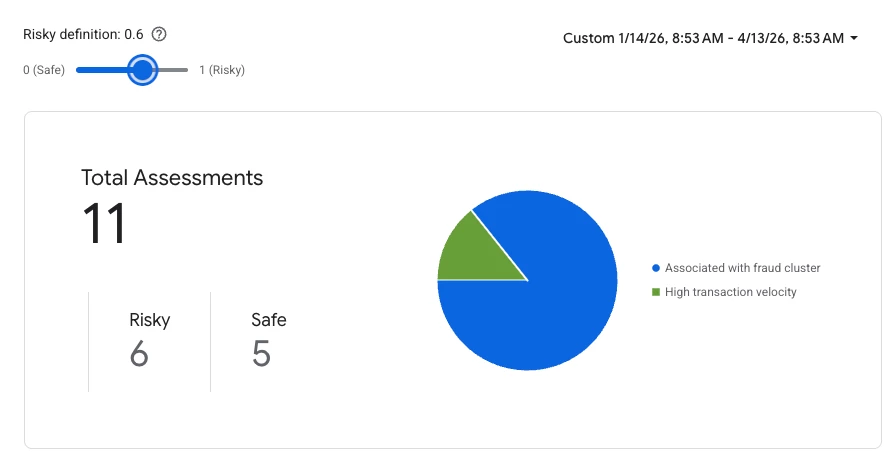
The Power of the Network: Google Cloud Fraud Defense’s network provided visibility that the incumbent solution could not match. It uncovered a massive "Super Cluster" of fraudulent activity connected to over 154 million historical transactions. This insight effectively doubled the team's ability to predict chargeback risk. Data showed that transactions from a known "Matched Fraudulent Cluster" carried a risk score of 0.51, compared to just 0.21 for other entities.
Actionable Explainability: Rather than providing a black-box risk score, Transaction defense offered human-readable "explainability reasons," such as HIGH_TRANSACTION_VELOCITY. This transparency allowed the client's fraud team to make faster, more confident decisions.
A Decisive Victory
After a thorough evaluation, Transaction Defense emerged as the clear winner. The most critical finding was in the false positive rate which was nearly half that of the incumbent solution.
This meant the customer could block the same amount of fraud while rejecting 50% fewer legitimate orders—directly protecting revenue and customer sentiment. Following this success, the company moved to a full production rollout across 100% of its US locations.
Why It Matters
This success story highlights the critical advantages of modernizing fraud defense:
- Scale: Leveraging technology that analyzes billions of signals globally.
- Precision: Using the network to uncover hidden fraud rings.
- Experience: Protecting mobile apps and web transactions without visible friction.
As fraud techniques become more advanced, businesses need defenses that learn and adapt. For this QSR leader, Google Cloud Fraud Defense provided the perfect recipe for secure, scalable growth.
Ready to secure your transactions? Visit Google Cloud Fraud Defense to learn more.
