



Authors:
Josue (Sway) Fontanez, Sr. Product Manager
Pablo Gonzalez, Sr. Software Engineer
Every day, people are asking AI agents to do their legwork on the web—from comparing flights and checking inventory to buying concert tickets and summarizing articles. But when an agent visits a website on a user's behalf, it creates an immediate blind spot: to a traditional security tool, a helpful AI shopping assistant and a malicious scraping bot look almost identical. Website owners are caught in a dilemma: block all automated traffic and lock out real customers using AI agents; or, let all automation through and expose your site to fraud, data theft, and account takeovers.
Solving this requires a reliable way to separate legitimate automation—from autonomous AI agents to trusted search crawlers and service bots—from malicious traffic. With Google Cloud Fraud Defense—the evolution of reCAPTCHA, which protects over 14 million websites—that starts with Agent and Bot Identification.
Defining the Landscape: "Verified" vs. "Suspected" Agents and Bots
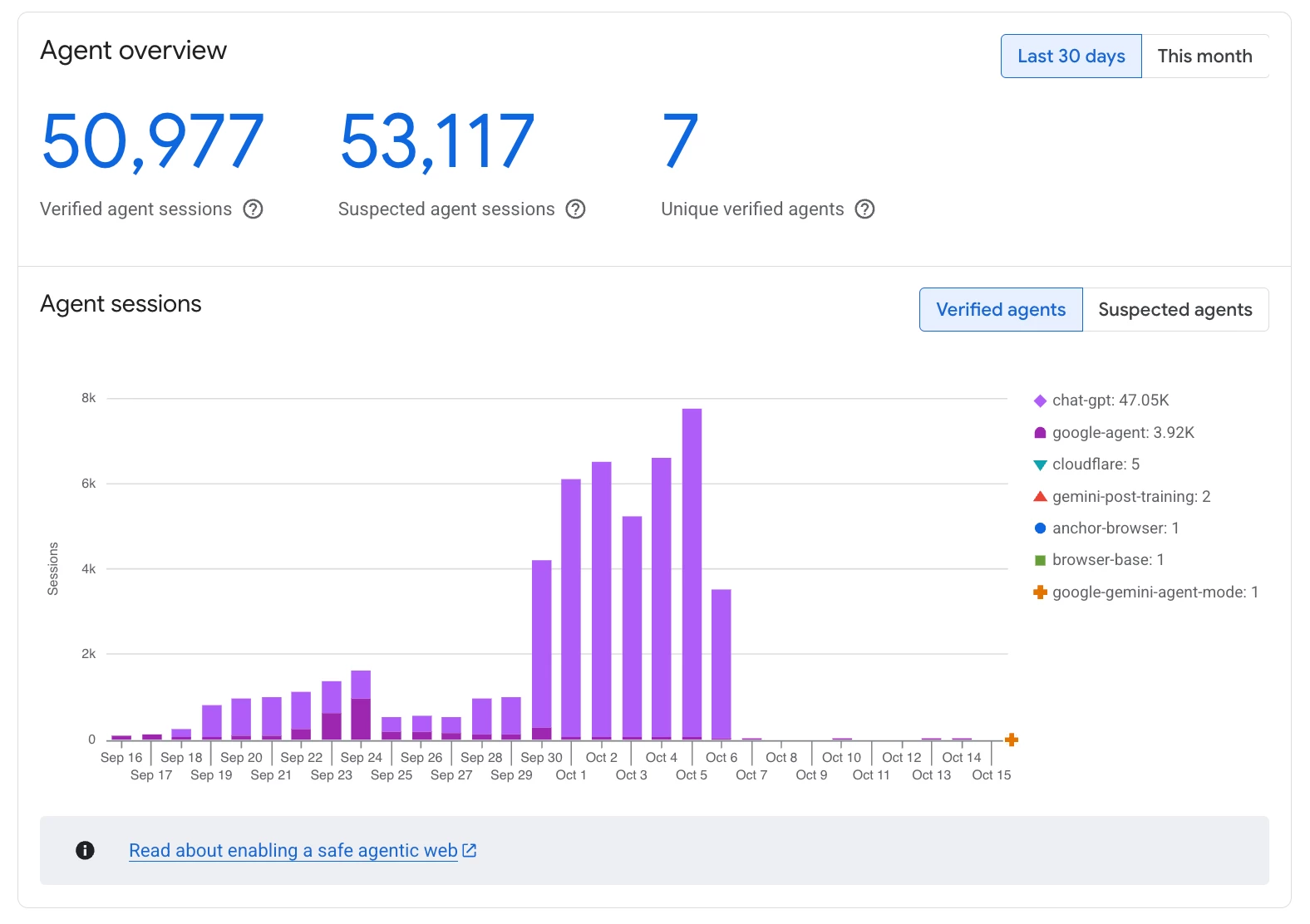
To give security teams clear visibility into how automated tools interact with their sites, Fraud Defense groups agentic and bot traffic into two categories in our dashboards and verdicts:
-
Verified: Self-declared agents and bots whose identity has been validated by Fraud Defense— through cryptographic signatures using Web Bot Auth (WBA), or verified User-Agent strings paired with published IP ranges or reverse DNS.
-
Suspected: Undeclared agents and bots that don't self-identify and are detected by Fraud Defense's behavioral and machine learning models.
How Fraud Defense Identifies Agents and Bots
Because bot traffic ranges from transparent search crawlers to undeclared autonomous agents, relying on a single detection method leaves huge blind spots. Fraud Defense pairs deterministic identity checks with behavioral machine learning to catch both.
1. Deterministic Identification: Web Bot Auth (WBA) and UA/IP Validation
When an agent or bot declares itself, Fraud Defense verifies its identity so site owners know the request actually comes from its claimed operator:
-
Web Bot Auth (WBA): Our preferred standard for agents and bot operators. WBA uses cryptographic HTTP Message Signatures backed by publicly verifiable keys, providing robust proof of origin.
-
Verified User-Agent (IP ranges or Reverse DNS): Fraud Defense also validates declared User-Agent strings against published egress IP blocks and reverse DNS records.
Knowing who built an agent or bot is only step one—security teams also need to know what it does. Sharing extra context—like its category, purpose, and documentation link—either inside WBA signature metadata or directly with Fraud Defense turns a raw identity check into useful security context.
2. Behavioral ML Models: Catching the Undeclared Majority
Self-declaration is only half the picture. Across Fraud Defense's global intelligence—spanning over 14 million domains and 50% of the Fortune 100—we estimate that over 50% of agentic web traffic today is completely undeclared.
Why do so many agent and bot builders choose not to declare their traffic? Often, developers worry that if they label their requests as automated, websites will automatically block them. In an attempt to avoid friction, many builders configure their agents and bots to look like standard human users.
In practice, this stealth approach backfires. When an undeclared agent or bot tries to mimic a human browser session, it exhibits the exact same evasive traits as sophisticated credential-stuffing, scraping, and fraud bots. To Fraud Defense's machine learning models—which continuously evaluate a wide array of signals across billions of events—attempting to disguise automation as human activity is a strong negative indicator. Rather than achieving smooth access, undeclared agents and bots attempting to mimic humans are flagged as Suspected, frequently resulting in blocking and visual challenges, including our new AI-resistant visual challenges that force a human-in-the-loop (HITL) and halt autonomous workflows in their tracks.
Why Self-Identification Wins: From Unwanted Noise to Business Value
Identifying your agent or bot isn't just a favor to security teams—it's a win for both website owners and builders.
For Website Owners: Smarter Rules and Clean Analytics
Contrary to the fear that declaring an agent or bot leads to an automatic block, modern enterprises actually want to welcome legitimate commercial agents and helpful bots—provided they can distinguish them from malicious scrapers and keep their downstream business metrics clean.
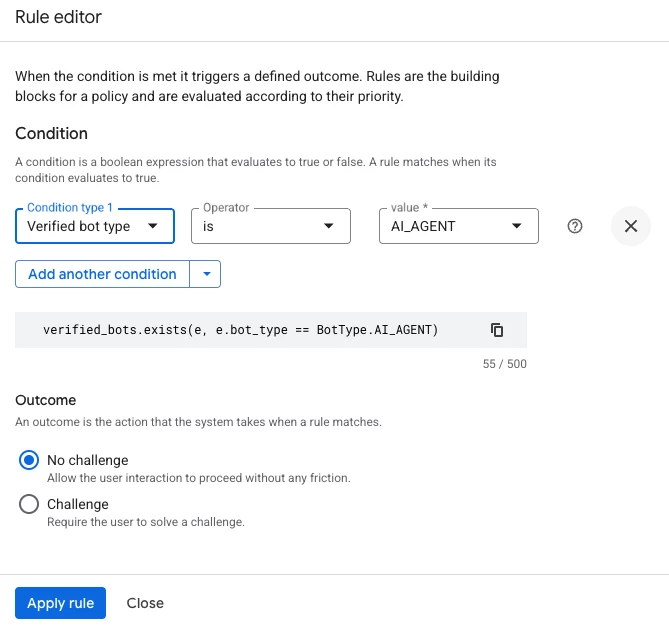
When an agent or bot identifies itself, site owners can use Fraud Defense to make surgical, policy-driven decisions across the customer journey (for example, allowing verified shopping assistants and search crawlers while blocking unauthorized data harvesters). It also helps marketing and analytics teams separate agent and bot activity from human visits so automated traffic doesn't skew conversion funnels and ad spend. Identification is what transforms legitimate agents and bots from unwanted noise into attributed business value.
For Agent Builders and Bot Operators: Better Reputation and Less Friction
For agent developers and bot operators, verifying your traffic with Web Bot Auth is a strong first step toward building a trusted reputation with Fraud Defense—instantly extending that trust across the 14 million+ websites protected by our global network.
Think of self-identification like showing an ID badge at the front door. When an agent or bot verifies who it is, our models don't penalize your traffic simply for being automated or assume it's an evasive bot trying to sneak in disguised as a human. We factor that verified identity into our risk evaluations, making it much less likely that your workflows will get interrupted by a challenge. Of course, an ID badge isn't a license to cause harm—Fraud Defense still watches for abusive behavior to keep our customers safe—but identifying yourself is the best way for legitimate agents and bots to browse and transact smoothly.
A Call to Action for Agent Builders and Bot Operators
As the agentic web scales, the era of anonymous, stealth automation is rapidly coming to a close. To build a durable, trusted ecosystem where legitimate agents and bots can thrive, we are issuing a call to action across two critical groups in the agent and bot community:
1. Agent Builders and Bot Operators: Sign Your Traffic with Web Bot Auth
Whether you are building an autonomous agent or operating a legitimate search crawler, fetcher, or monitoring bot, stop relying on easily spoofed User-Agent strings or attempting to blend in as human traffic. Adopt the Web Bot Auth standard to cryptographically sign your requests, and pair your signatures with rich operational metadata with Fraud Defense. Declaring who you are—and what your automation is built to do—is the best way to earn trust with enterprise websites and build a strong reputation across our network. Today, we are working closely with agent builders and traditional bot operators to onboard and verify their signed traffic in Fraud Defense—with a self-service registration path coming soon.
2. Agent and Bot Platforms: Solve the "Noisy Neighbor" Problem
Many developers build and run agents and bots on shared cloud and browser platforms. When thousands of independent agents and bots share the same egress IPs or a single platform signature without workload-level separation, a few bad actors running unauthorized scrapers or credential-stuffing attacks can degrade the reputation of the entire platform—turning legitimate agents and bots into collateral damage.
To prevent this "noisy neighbor" effect, agent and bot platforms should:
-
Sign platform traffic with Web Bot Auth (WBA): Provide cryptographic proof out of the box that traffic originates from managed infrastructure.
-
Distinguish individual sub-tenants, agents and bots: Include sub-tenant or workload-level identifiers in signed requests so Fraud Defense can isolate a single bad actor without penalizing your whole platform or the legitimate builders on it.
Building the Trusted Agentic Web Together
A healthy web comes down to transparency, verifiable identity, and trust. With Google Cloud Fraud Defense, we are giving businesses the visibility and controls they need to safely welcome helpful automation—while giving agent builders and bot operators a clear path to operate smoothly across the web.
To see how Fraud Defense classifies Verified and Suspected agent and bot traffic across your applications today, explore the Fraud Defense documentation or log directly into the Google Cloud Console
