
Author:
Tarah Lewis, Global Security Architect
Introduction
This blog is intended for security practitioners, enterprise architects, and compliance officers operating within regulated Operational Technology (OT) environments. It provides an actionable blueprint for teams trying to securely orchestrate real-time telemetry pipelines to the cloud and scale advanced threat analytics under NERC CIP frameworks.
Introduction to NERC CIP
The North American Electric Reliability Corporation (NERC) Critical Infrastructure Protection (CIP) standards represent a mandatory, highly enforced cyber and physical security framework designed to protect North America's Bulk Electric System (BES). Day-to-day compliance monitoring and regional enforcement guidelines are managed by NERC and executed locally across six Regional Entities (MRO, NPCC, ReliabilityFirst, SERC, TRE, and WECC). Non-compliance carries extremely severe financial consequences, with civil penalties scaling up to $1.2M+ per violation per day. This enforces an incredibly conservative, risk-averse posture among Operational Technology (OT) operators, characterized by complete physical isolation of control networks (often termed 'islanding').
However, modern threat vectors targeting critical infrastructure require a shift from isolated defense to centralized, continuous visibility. Under FERC Order No. 907, approved on June 26, 2025, the regulatory landscape formalizes this transition by adopting NERC Reliability Standard CIP-015-1: Cyber Security – Internal Network Security Monitoring (INSM). CIP-015-1 mandates that registered entities implement continuous internal security monitoring within their Electronic Security Perimeters (ESPs) to detect anomalous network activity. This standard applies to all high-impact and medium-impact Bulk Electric System (BES) Cyber Systems.
A persistent industry misconception asserts that NERC CIP standards prohibit transmitting any security telemetry from the OT environment to a cloud-native Security Information and Event Management (SIEM) system. In truth, NERC regulations—specifically CIP-007-6 (System Security Management) and CIP-011-3 (Information Protection)—mandate that a copy of audit and security log data must remain available inside the secure environment; they do not prohibit maintaining a duplicate egress stream. By utilizing Google Security Operations paired with Bindplane Enterprise, organizations can deploy an architecture that satisfies local data custody audits while leveraging modern, cloud-scale threat analytics to secure their critical assets.
| Compliance Message: NERC CIP requires that a copy of security data remains in your environment, however, it does not forbid a secondary copy from leaving. Google SecOps and Bindplane Enterprise allow you to establish a defensible dual-custody architecture that satisfies regulators while providing complete, multi-domain visibility. |
Current Approach Challenges
Legacy utility security architectures suffer from systemic vulnerabilities that undermine real-time threat detection and rapid response capabilities. Because on-premises SCADA and OT security telemetry have historically been treated as isolated operational silos, organizations are left with highly fragmented "islands of data". This lack of a unified, comprehensive visibility platform leaves security teams blind to lateral threat progression and cross-domain attack campaigns. Since nearly every sophisticated OT compromise originates with an initial IT-side intrusion—which then serves as the pathway into the control network—it is operationally impossible to spot these multi-stage attacks without continuous, correlated visibility across both IT and OT environments.
Furthermore, security platforms deployed deep inside the Electronic Security Perimeter (ESP) are typically air-gapped or heavily restricted from inbound communications. Consequently, on-premises Endpoint Detection and Response (EDR) or Network Intrusion Detection (NIDS) tools quickly fall weeks or months behind on critical threat intelligence feeds, indicator of compromise (IOC) updates, and detection signatures because they cannot automatically pull these updates across the boundary. This visibility gap is further worsened by fragmented organizational telemetry; a typical utility frequently maintains multiple separate OT environments—such as distinct logging infrastructures for strictly regulated, high- and medium-impact BES Cyber Systems versus standard, non-BES SCADA networks. Operating without centralized visibility makes it impossible to apply unified detection rules across the organization.
This document outlines a modern reference architecture that resolves legacy monitoring limitations—integrating Google SecOps and Bindplane Enterprise to deliver centralized, real-time threat detection while strictly maintaining NERC CIP compliance.
Deployment Requirements
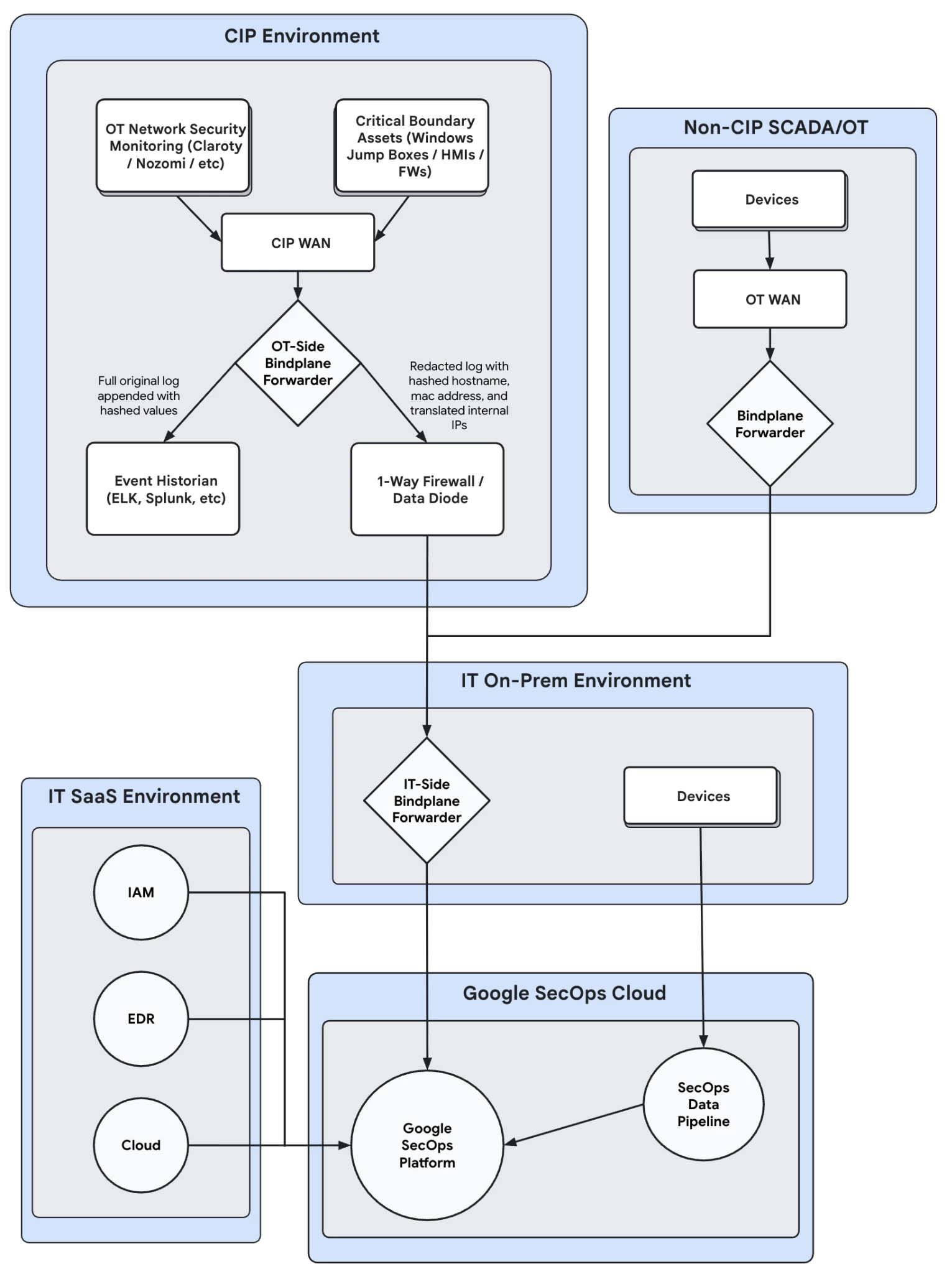
To deploy a solution supportive of NERC CIP compliance, the reference architecture divides responsibilities between three main functional elements: local storage, secure telemetry processing, and stateful networking. The solution hinges on the Google SecOps reference design, which incorporates an on-premises 'Event Historian' and dual Bindplane forwarder nodes.
Maintaining a Local Copy
To satisfy NERC CIP audit trail and information storage rules (specifically CIP-007-6 Requirement R4 governing security event monitoring, and CIP-009-6 governing recovery planning), the responsible entity's secure CIP environment must host a local log repository, referred to as the Event Historian. Typically built on existing on-premises clusters like Elastic or Splunk, the Event Historian is positioned inside the SCADA/OT network boundary. It stores the full, unredacted, and un-obfuscated telemetry generated by OT systems, security devices, and network intrusion detection systems (IDS) such as Nozomi, Claroty, or Forescout. Because this localized repository sits within the ESP boundary, it operates as a Protected Cyber Asset (PCA) subject to strict CIP-010 configuration change management controls. This dual-custody architecture mitigates operational update friction by allowing the on-premises environment to maintain an isolated forensic baseline while Google SecOps handles high-velocity security analytics in the cloud.
Every log generator inside the ESP directs its raw telemetry to the CIP-side forwarder, which ensures that a complete, unredacted copy of all events is immediately committed to this local on-premises Event Historian. This local system acts as the primary forensic store for on-site operations and local incident response, guaranteeing that even if the connection to the cloud is physically severed, a complete audit trail remains fully intact within the secure environment.
Obfuscation and Tagging with Bindplane
While NERC standards do not prohibit cloud-scale analysis, CIP-011-3 (Information Protection) strictly regulates the storage, transit, and exposure of Bulk Electric System Cyber System Information (BCSI). Exposing raw system hostnames (which frequently reveal operational functions, e.g., 'uranium-rod-controller-1' or 'generator-3-turbine') or physical MAC addresses outside the substation boundary is an unacceptable risk. This architecture resolves this challenge via Bindplane Enterprise deployed within the secure OT environment.
Bindplane acts as a secure, local pipeline broker, executing the dual-routing split. Crucially, before bifurcating the data, Bindplane appends the deterministic, one-way cryptographically hashed values of the hostname and MAC address as new metadata fields (such as hostname_redacted and mac_redacted) directly to the active event. The unredacted stream committed to the local Event Historian contains the full, unredacted event with these hashed values appended to it. This creates a self-contained, on-prem lookup index directly inside the log history. Meanwhile, a secondary outbound stream undergoes in-flight sanitization where the raw fields are swapped with their hashed equivalents before crossing the Electronic Security Perimeter:
-
One-Way Cryptographic Hashing: Sensitive fields—specifically hostnames and physical MAC addresses—are hashed using a cryptographically secure, one-way hash (such as SHA-256) inside the CIP-side forwarder to enrich the log stream. Because this hashing is deterministic, Google SecOps maintains unbroken threat correlation (tracking a single hashed entity across multiple security events over time). When security teams identify a detection in Google SecOps on a hashed host, an analyst simply takes the hash value and queries it directly in the local Event Historian to instantly resolve the physical asset identity, completely eliminating the need to maintain insecure external translation tables.
-
Logical IP Substitution and Site-Specific Translation: To prevent exposing internal network topologies and satisfy conservative interpretations of information protection policies, internal IP schemas can be logically substituted before leaving the perimeter. This is particularly critical in replicated OT environments—such as wind farms or other standardized substation footprints—that reuse identical RFC-1918 IP blocks across multiple locations).
To prevent overlapping IP space and enable accurate cloud-side threat analysis, Bindplane evaluates incoming telemetry streams to identify their physical origin using contextual boundary metadata, such as the unique MAC or IP address of the localized network gateway or hardware bridge. Based on this gateway context, Bindplane dynamically translates duplicated internal IPs into unique, site-specific subnets (e.g., Substation A's 192.168.1.X range translates to 10.1.1.X, while Substation B's identical 192.168.1.X range translates to 10.1.2.X). This dynamically establishes a true one-to-one logical correlation map in Google SecOps, allowing security practitioners to resolve the physical asset identity, while leaving external IP addresses completely unredacted to support automated threat intelligence matching.
-
Contextual Tagging (OT vs. IT): All logs egressing the CIP environment must be labeled with tags like 'SCADA', 'OT', or 'ICS'. This enables targeted detections in Google SecOps. For example, a DNS query to a public resolver like 8.8.8.8 is standard in IT but is an extremely high-priority indicator of compromise (IOC) or policy violation in an OT environment. Tagging prevents false positives in IT datasets while raising instant alarms for SCADA telemetry.
| Hashing vs Randomization: Completely stripping or randomizing sensitive identifiers to comply with CIP-011-3 renders SIEM analytics useless. Because multi-stage cyber attacks are detected by analyzing sequential alerts on a single asset over time (such as host reconnaissance followed by lateral port scanning), consistency is essential. One-way cryptographic hashing is highly superior to randomization because it anonymizes sensitive operational data while preserving the mathematical correlation necessary for advanced threat detection. While resolving these hashes requires a documented, high-fidelity lookup process against the local Event Historian—which operates as a Protected Cyber Asset (PCA) with strict access constraints—this architecture maximizes efficiency. It allows cloud-side analysts to complete the bulk of the behavioral triage before a verified incident ever justifies the formal operational friction of pulling raw asset identities from the secure environment. |
Networking
Boundary security is governed by CIP-005-7 (Electronic Security Perimeter), which mandates strict control of inbound and outbound communication paths. Historically, operators have implemented data diodes—electrically or optically isolated one-way connections that physically sever the receive wires coming from the IT environment. While highly secure, data diodes force syslog forwarding over non-stateful UDP. In production environments, UDP syslog introduces severe operational vulnerabilities: it restricts the maximum packet size to 1,500 bytes (truncating verbose XML or JSON logs from modern OT network intrusion detection sensors like Nozomi, Claroty, or ForeScout), and it offers no recovery mechanism, leading to permanent data loss during transient network congestion.
The recommended standard is to configure a stateful, one-way firewall rule that permits outbound TCP connections from the OT-side Bindplane forwarder to the IT-side Bindplane forwarder. To ensure absolute data protection across the ESP boundary, this egress-only stream may be strictly encrypted using TLS 1.3 (or TLS 1.2) with mutual authentication (mTLS), ensuring zero inbound routable connectivity. Because the connection is initiated solely from the high-side (inside the ESP), the firewall blocks any inbound-initiated connection attempts. The stateful nature of TCP supports local buffering; during deliberate network 'islanding' exercises or unexpected WAN outages, the CIP-side Bindplane forwarder caches telemetry locally and automatically replays and re-syncs the buffered logs to Google SecOps once the connection is re-established, eliminating the risk of compliance-violating log gaps.
Auditing
To satisfy the documentation and evidence requirements of Regional Entities during compliance audits, security teams must prove that sensitive BCSI never leaves the physical CIP boundary. This architecture supports a built-in, three-tier validation strategy:
-
Dual-Filter Configuration Verification: Auditors can visually inspect the configuration file of the CIP-side Bindplane forwarder to verify the hashing processor. To provide defense-in-depth, secondary regex filter rules are applied to the IT-side Bindplane forwarder. These rules are configured to detect, block, and log any plain-text hostnames or MAC formats, acting as a failsafe that prevents accidental leakage.
-
Raw Log Audits: Compliance practitioners can execute a raw log search in Google SecOps for expected operational phrases, common substring patterns, or naming conventions (e.g., searching for parts of strings like ‘turbine’, ‘controller’, or ‘generator’ using wildcard and regular expression syntax) rather than querying explicit, full system hostnames. Proving that these pattern-based searches return zero raw, unredacted matches provides audit-ready evidence of redaction efficacy without exposing the sensitive, exact identities of physical assets in cloud-side search histories.
-
Continuous YARA-L Monitoring: Security practitioners can write a continuous YARA-L detection rule in Google SecOps that alerts immediately if any incoming telemetry matches unredacted physical formats. Rather than loading a highly sensitive static list of raw hostnames into the rule, the detection logic can utilize regex pattern matching to scan incoming payloads for protected internal IP schemas, generalized asset naming-convention regex (such as identifying any unredacted string containing a localized substation prefix followed by a numeric identifier), or standard MAC address formats combined with a SCADA/OT contextual tag. This approach transforms compliance validation into an automated, real-time, self-monitoring control while strictly enforcing the information protection principles of CIP-011-3.
-
Cloud Governance Hardening: To enforce strict data sovereignty, the Google SecOps environment can be deployed within an Assured Workloads folder. This is paired with Customer-Managed Encryption Keys (CMEK) backed by an on-premise External Key Manager (EKM), ensuring the utility retains ultimate cryptographic control over all cloud-hosted log payloads and key material.
Mapping of NERC CIP Requirements to Proposed Architecture
| NERC CIP Standard & Req. | Compliance & Architectural Challenge | Google SecOps + Bindplane Solution Control |
| CIP-002-8 (Scoping) System Categorization | Recent AWV score updates transition Low-Impact Control Centers to Medium-Impact, requiring rapid onboarding of security event logging. | Bindplane deploys seamlessly across systems to collect granular telemetry close to the ESP boundary, ensuring compliance and audit-ready operations. |
| CIP-005-7 Electronic Security Perimeter | Managing telemetry egress from the ESP without exposing internal network topologies or violating strict firewall boundary policies. | Uses stateful, outbound-only TCP forwarding initiated strictly inside the ESP. Firewall blocks inbound traffic while supporting secure log transit. |
| CIP-007-6 R4 System Security Management | Ensuring complete collection and continuous monitoring of critical event logs (such as Windows jump boxes, SCADA firewalls, and EDR feeds). | Mandating continuous internal network visibility to detect lateral threat movement, anomalous activity, and reduce attacker dwell time. |
| CIP-009-6 Recovery Plans & 'Islanding' | Maintaining logging capability during deliberate network 'islanding' recovery tests or transient WAN outages without log data loss. | TCP-based stateful forwarding enables localized buffering inside the CIP-side forwarder, automatically replaying and re-syncing logs upon reconnection. |
| CIP-010-4/5 Configuration Change Management | Managing software updates and pipeline baseline configurations for logging infrastructure operating as Protected Cyber Assets (PCAs) inside the ESP. | Bindplane Enterprise manages localized data collection pipelines through strict baseline monitoring and secure software tracking. Moving telemetry processing and high-velocity detections into Google SecOps drastically minimizes the local on-premises change control loop burden on the physical PCA. |
| CIP-011-3 Information Protection | Preventing sensitive Bulk Electric System Cyber System Information (BCSI), such as hostnames and MACs, from leaving the secure perimeter. | Applies one-way deterministic cryptographic hashing (MD5) to hostnames and MAC addresses in-flight, preserving SIEM correlation without exfiltrating BCSI. |
| CIP-015-1 Internal Security Monitoring | Mandating continuous internal network visibility to detect lateral threat movement, anomalous activity, and reduce attacker dwell time. | Ingests verbose sensor telemetry (Nozomi, Claroty, ForeScout) via Bindplane into Google SecOps, driving continuous advanced behavioral detection. |