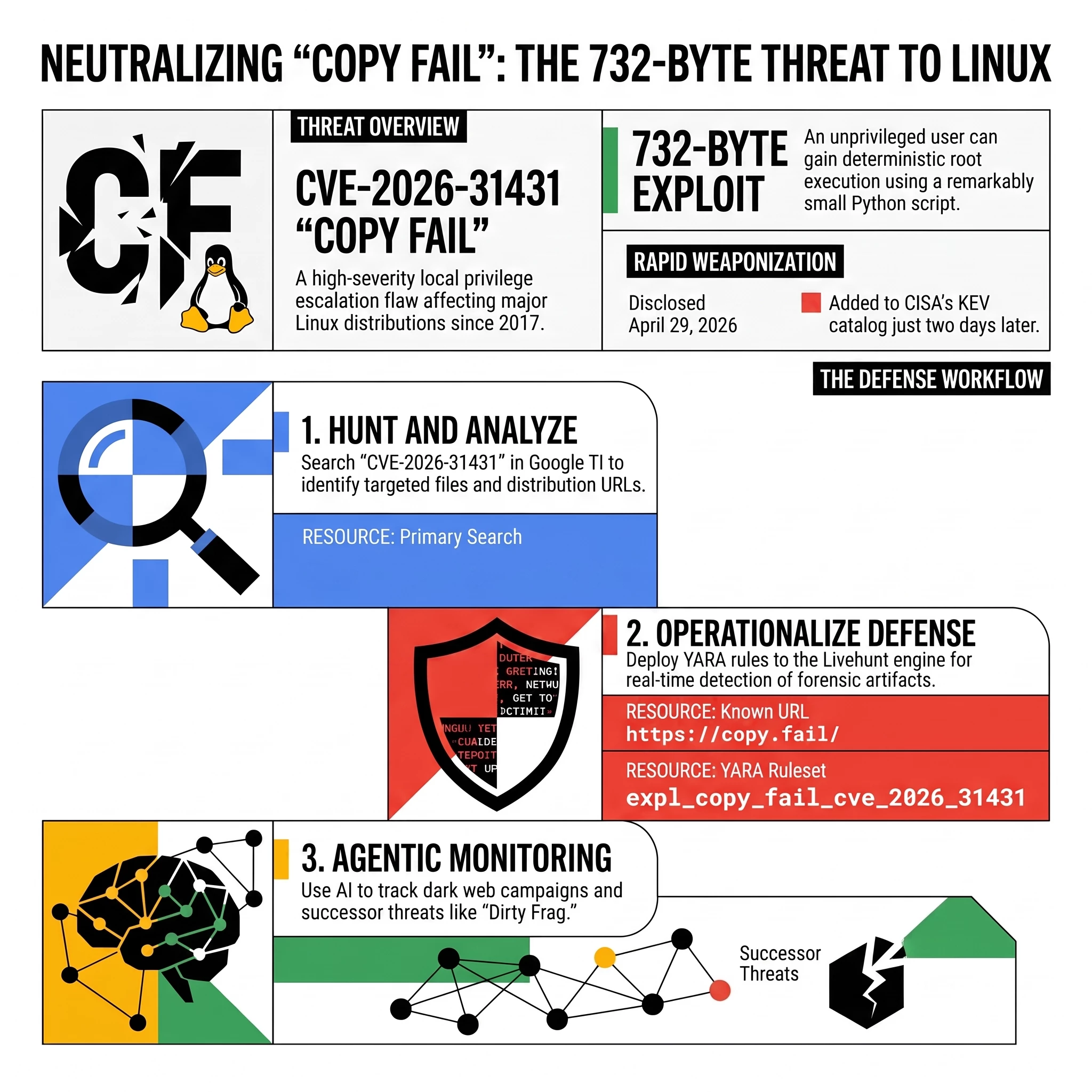

The global security landscape recently faced a substantial challenge with the disclosure of CVE-2026-31431, an impactful zero-day logic flaw widely known as "Copy Fail". Residing within the Linux kernel's cryptographic subsystem, this high severity local privilege escalation vulnerability has quietly affected major enterprise distributions since 2017. Alarmingly, an unprivileged local user can gain deterministic root execution using a remarkably small 732 byte Python script, making swift detection an absolute priority for system administrators.
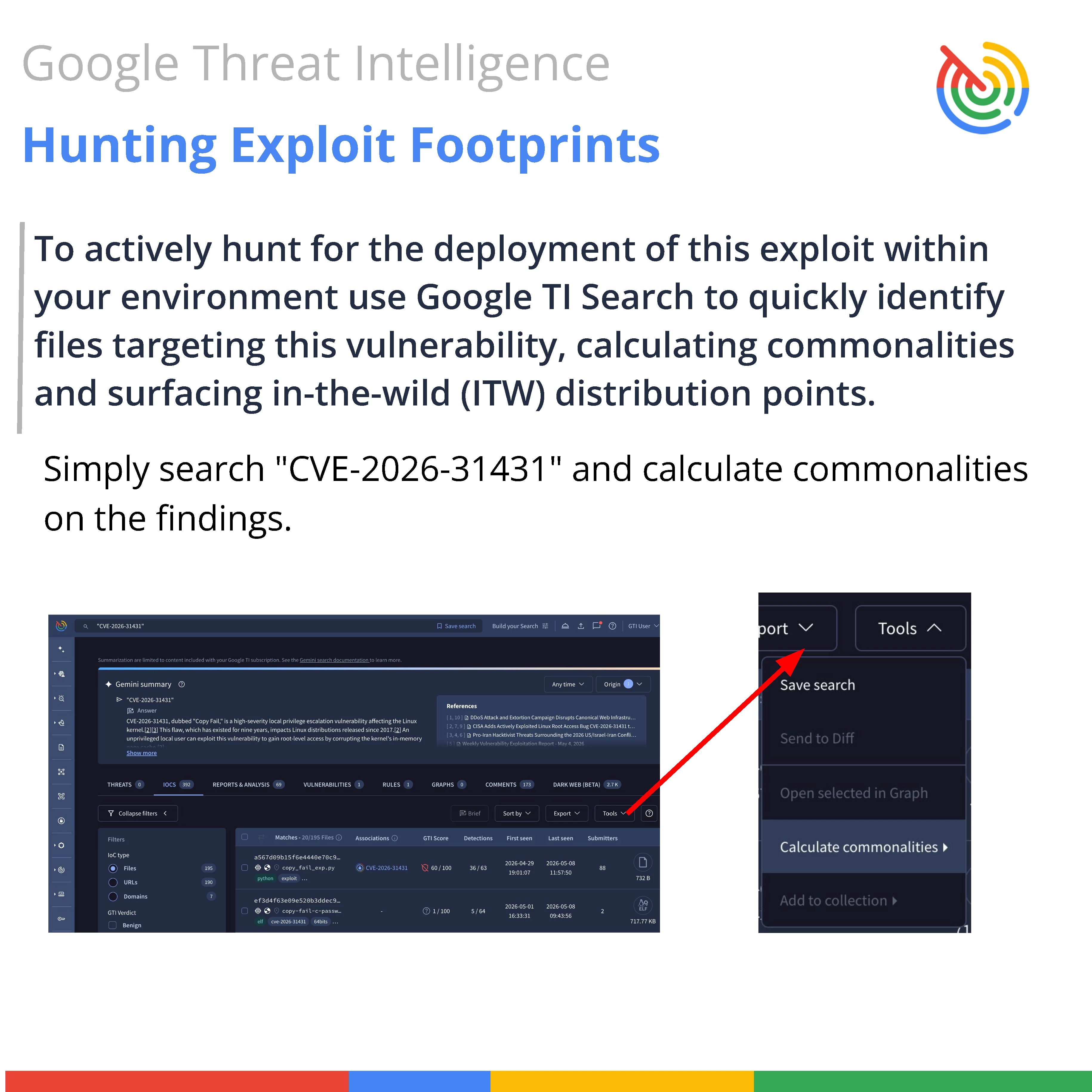
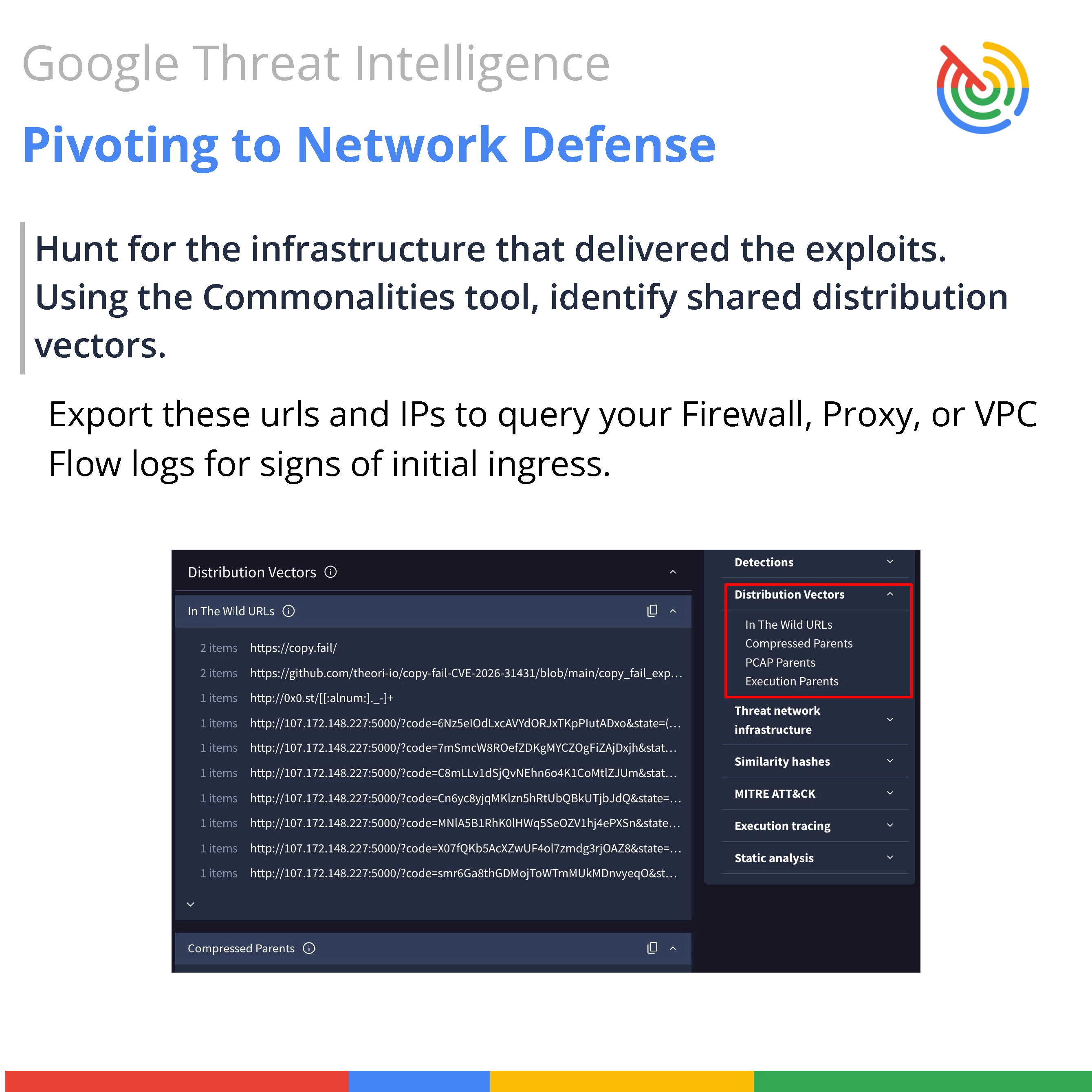
To help organizations counter this critical threat, Google Threat Intelligence offers robust capabilities to hunt, analyze, and neutralize exploit footprints before they disrupt production environments. Security teams can leverage Google Threat Intelligence Search to quickly identify targeted files, calculate commonalities on the findings, and map out in the wild distribution points. This effectively allows analysts to uncover the exact malicious infrastructure and distribution URLs associated with the delivery of the threat.
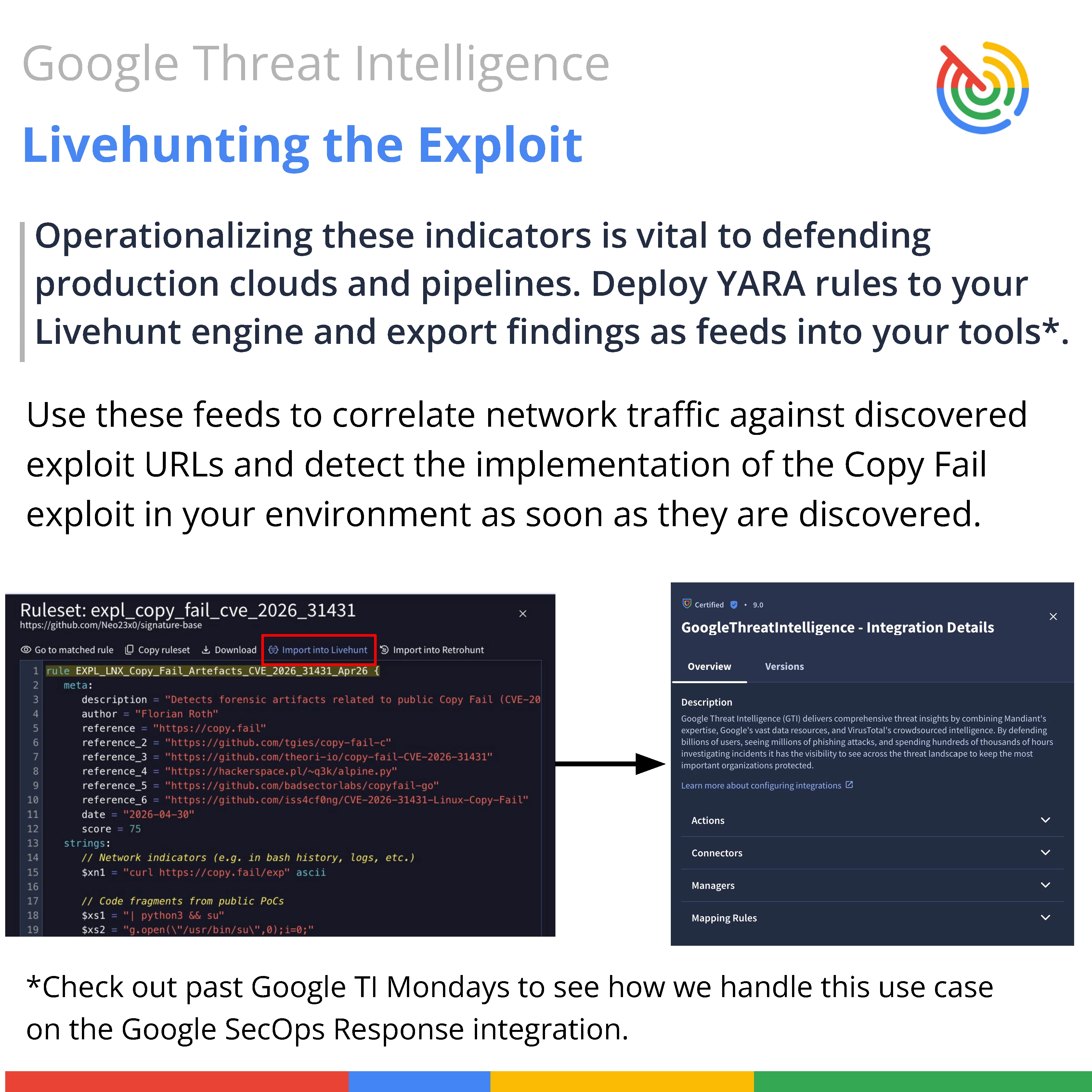
Moving from discovery to active defense, teams can pivot to network protection by exporting these identified distribution vectors directly into firewall, proxy, or VPC flow logs to catch signs of initial ingress. Operationalizing these threat indicators is further streamlined by deploying tailored YARA rules into the Livehunt engine. This proactive approach ensures real time detection of forensic artifacts and exploit implementations within production clouds and active development pipelines.
Security teams can instantly generate comprehensive debriefs, monitor deep web forums for active exploitation campaigns, and keep track of fast moving variations. This agentic capability helps teams stay ahead of developments, such as the vulnerability's addition to CISA's Known Exploited Vulnerabilities catalog or the emergence of successor threats like "Dirty Frag". By combining automated intelligence with advanced network defense, organizations can maintain a resilient posture against this severe kernel exploit.