



Author: Wajih Yassine, Security Engineer, Google Threat Intelligence Group
When responding to a security incident, speed and context determine how quickly a team can contain a threat. Responding to raw forensic disk images traditionally requires slow, manual triage steps—identifying partitions, scraping signature repositories, researching file paths and hashes, and running local file analysis tools. This repetitive process creates friction when attempting to reconstruct the full scope of an intrusion.
Google Threat Intelligence and its agentic capabilities can be paired with open source tools to build automated DFIR workflows. By combining containerized evidence processing with threat intelligence enrichment, responders can quickly move from an unmounted disk image to an actionable threat assessment.
In this post, we demonstrate a proof-of-concept (PoC) workflow using OpenRelik that automates end-to-end forensic triage—replacing manual data gathering and static signature matching with dynamic YARA rule curation, containerized scanning, agentic threat synthesis mapped to MITRE ATT&CK, and automated binary analysis.
Workflow at a Glance
Unlike monolithic architectures, OpenRelik decouples evidence processing into independent, containerized workers using popular open-source tools (such as Plaso, Hayabusa, or Capa) that can be chained together on a visual canvas. While we showcase a specific YARA-to-agentic-enrichment pipeline below as a practical example, OpenRelik's modular architecture and Google Threat Intelligence's agentic capabilities provide multiple ways to achieve similar outcomes depending on your team's telemetry and playbooks.
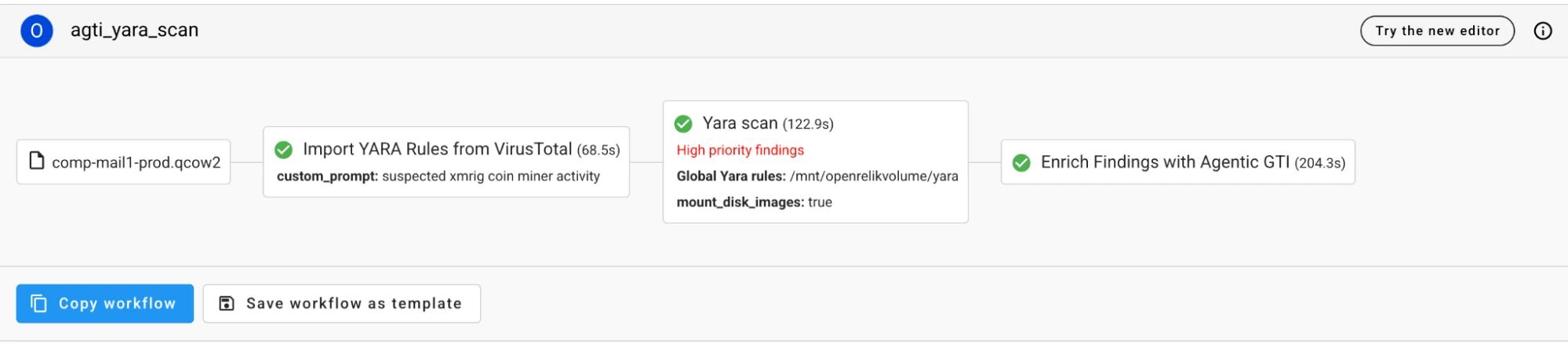
Our starting point is a forensic disk image (comp-mail1-prod.qcow2) acquired from a production Linux server following an alert for unauthorized outbound cryptocurrency mining traffic. In this scenario, we do not have an initial IP address or domain to pivot from, so we rely on host-based discovery.
To test and deploy this workflow in your own environment as you follow along, follow the instructions provided from the instructions OpenRelik Google Threat Intelligence Worker repo: https://github.com/openrelik-contrib/openrelik-worker-agti.
1. Context-Driven Rule Curation
With the environment set up, the workflow in Figure 1 begins by curating a targeted set of YARA detection rules tailored to the suspected incident—giving the scanner high-signal coverage without the overhead and false positives of a full signature repository.
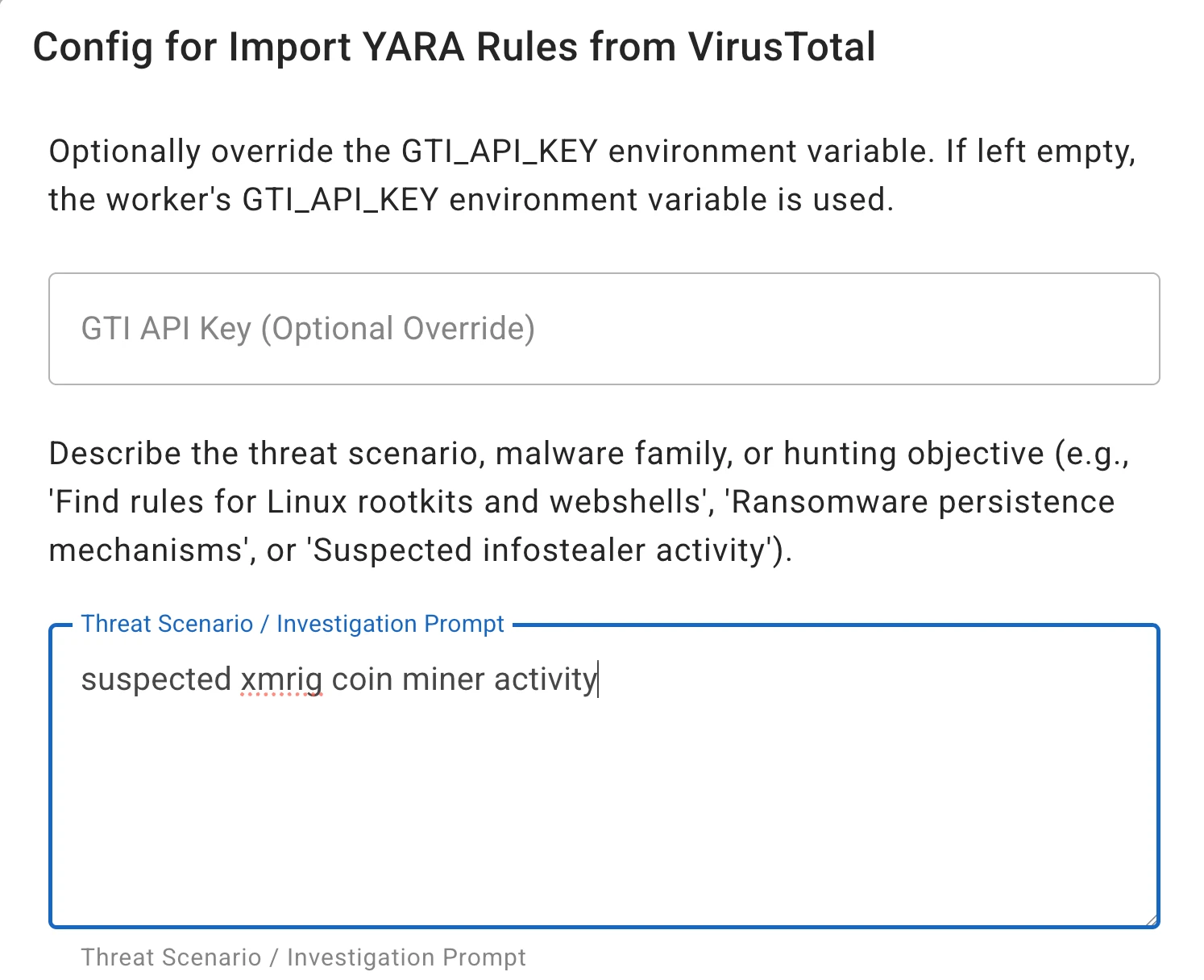
To automate rule curation, add the Google Threat Intelligence YARA Importer worker (`Import YARA Rules from VirusTotal`, the first node in Figure 1) to the OpenRelik canvas and describe the threat scenario in plain language:
-
Expand the Scenario Prompt: Enter a high-level investigation prompt—in this case, `suspected xmrig coin miner activity`. The worker uses Google Threat Intelligence's agentic capabilities to expand that prompt into 17 targeted search terms, including `xmrig`, `coinminer`, `cryptominer`, `minerd`, `monero`, `stratum`, `kinsing`, and `lemonduck`.
-
Pull and Stage Rules from the Hub: The worker queries the Google Threat Intelligence Crowdsourced YARA Hub (`/api/v3/yara_rules`) across those terms, deduplicates the matching community rules, and stages them directly on the shared OpenRelik storage volume (`/mnt/openrelikvolume/yara`) for the scanner.
2. Automated Forensic Disk Scanning with YARA
Next, the workflow scans the raw disk image against the curated YARA ruleset to pinpoint suspicious files across the host filesystem. To automate this without manually identifying partitions or managing loopback devices, pipe `comp-mail1-prod.qcow2` and the staged rule directory into the OpenRelik YARA worker (`Yara scan`, the second node in Figure 1) with `mount_disk_images` enabled:
-
Mount Partitions Read-Only: OpenRelik isolates filesystem access inside an ephemeral container, automatically mounting the partitions of `comp-mail1-prod.qcow2` as read-only to preserve evidence integrity.
-
Run Multi-Threaded YARA Scanning: The worker scans the mounted filesystem across multiple threads using the curated rules staged in `/mnt/openrelikvolume/yara`.
-
Structured Deliverables: The worker compiles matches into structured reports (yara-scan-report.md and fraken_out.jsonl), surfacing high-priority matches across /var/spool/exim4/input/, /etc/crontab, /var/log/cron.log, /tmp/tmpdkme0201/printspool, and a UPX-packed binary (jaq) inside a container overlay layer.
3. Synthesizing Findings with Google Threat Intelligence
Once the YARA scan finishes, the next step is to connect the individual rule hits across `comp-mail1-prod.qcow2` into a coherent incident timeline and determine how the intrusion unfolded.
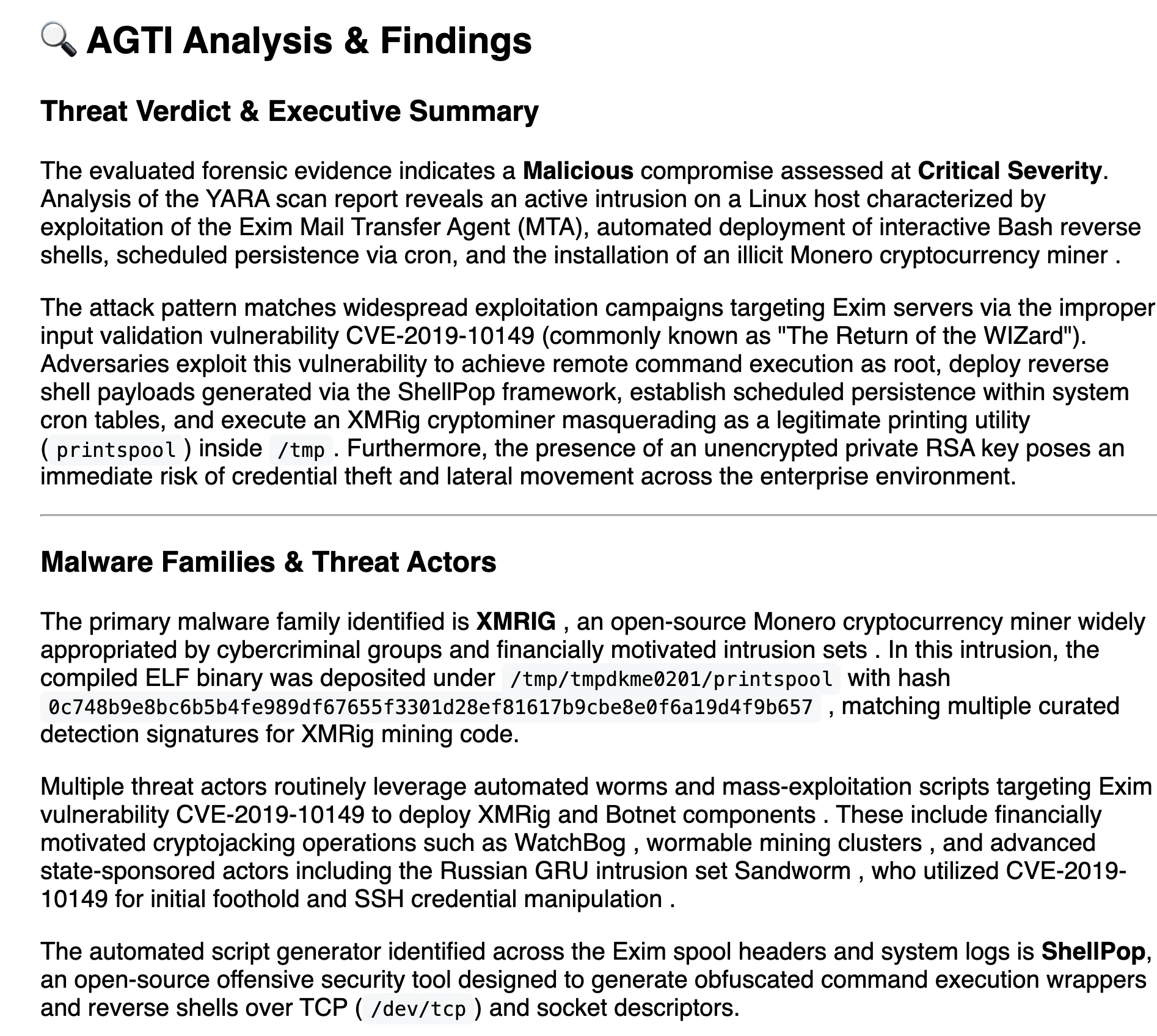
To automate this triage analysis, pipe the scan reports (`yara-scan-report.md` and `fraken_out.jsonl`) into the Google Threat Intelligence worker (`Enrich Findings with Agentic GTI`, the third node in Figure 1). The worker correlates the matched file paths, hashes, and YARA rules against global threat telemetry to generate an executive verdict, reconstruct a plausible intrusion sequence, and map each artifact to MITRE ATT&CK—giving responders immediate root-cause hypotheses to verify:
Plausible Intrusion Sequence
-
Initial Access and Exploitation: Files under /var/spool/exim4/input/ matched the signature SUSP_shellpop_Bash. Google Threat Intelligence correlated this specific spool directory layout with exploitation of unpatched Exim Mail Transfer Agents (CVE-2019-10149, also known as "The Return of the WIZard"), where malformed recipient strings allow remote command execution inside the spool queue. This gives responders an immediate verification step: prioritize auditing Exim daemon logs (/var/log/exim4/mainlog) rather than performing unbounded filesystem sweeps.
-
Command Execution and Persistence: Matches across /etc/crontab and /var/log/cron.log indicated that the threat actor established scheduled persistence to periodically relaunch interactive Bash reverse shells.
-
Payload Staging and Defense Evasion: The ELF binary at /tmp/tmpdkme0201/printspool (SHA-256: 0c748b9e8bc6b5b4fe989df67655f3301d28ef81617b9cbe8e0f6a19d4f9b657) matched XMRIG_Monero_Miner. Google Threat Intelligence flagged both the ephemeral directory path and the process name as deliberate masquerading: renaming an XMRIG Monero cryptocurrency miner after a legitimate Linux printing daemon (printspool) to evade process table inspections (ps aux).
-
Secondary Exposure and Lateral Movement: The presence of an unencrypted SSH private key at /home/user/.ssh/id_rsa was surfaced as a high-priority risk factor, prompting investigators to verify whether adjacent infrastructure accepts this credential.
MITRE ATT&CK Mapping
Google Threat Intelligence maps the observed evidence directly to standardized MITRE ATT&CK tactics and techniques for case reporting:
| Tactic | Technique / Sub-technique | Technique ID | Observed Evidence |
| Initial Access | Exploit Public-Facing Application | T1190 | Exim MTA input validation vulnerability CVE-2019-10149 via recipient strings |
| Execution | Command and Scripting Interpreter: Unix Shell | T1059.004 | ShellPop-generated interactive Bash reverse shells piped through /bin/sh |
| Persistence | Scheduled Task/Job: Cron | T1053.003 | Malicious job injected into /etc/crontab and logged in /var/log/cron.log |
| Defense Evasion | Masquerading: Match Legitimate Resource Name | T1036.005 | XMRig payload placed in /tmp/tmpdkme0201/ renamed as printspool |
| Defense Evasion | Obfuscated Files: Software Packing | T1027.002 | UPX-compressed ELF binary (jaq) deployed within containerd overlayfs snapshots |
| Credential Access | Unsecured Credentials: Private Keys | T1552.004 | Storage of unencrypted SSH RSA private key at /home/user/.ssh/id_rsa |
| Command & Control | Non-Application Layer Protocol | T1095 | Reverse shell sessions established over raw TCP sockets via /dev/tcp |
| Impact | Resource Hijacking | T1496 | Execution of Monero miner XMRig consuming host CPU cycles |
Figure 4: MITRE ATT&CK mapping correlating host evidence to threat tactics
Deep Indicator and Telemetry Verification
In addition to behavioral synthesis, Google Threat Intelligence extracts candidate indicators of compromise (IOCs) from the scan data and validates them against global detection ratios and enterprise prevalence telemetry:
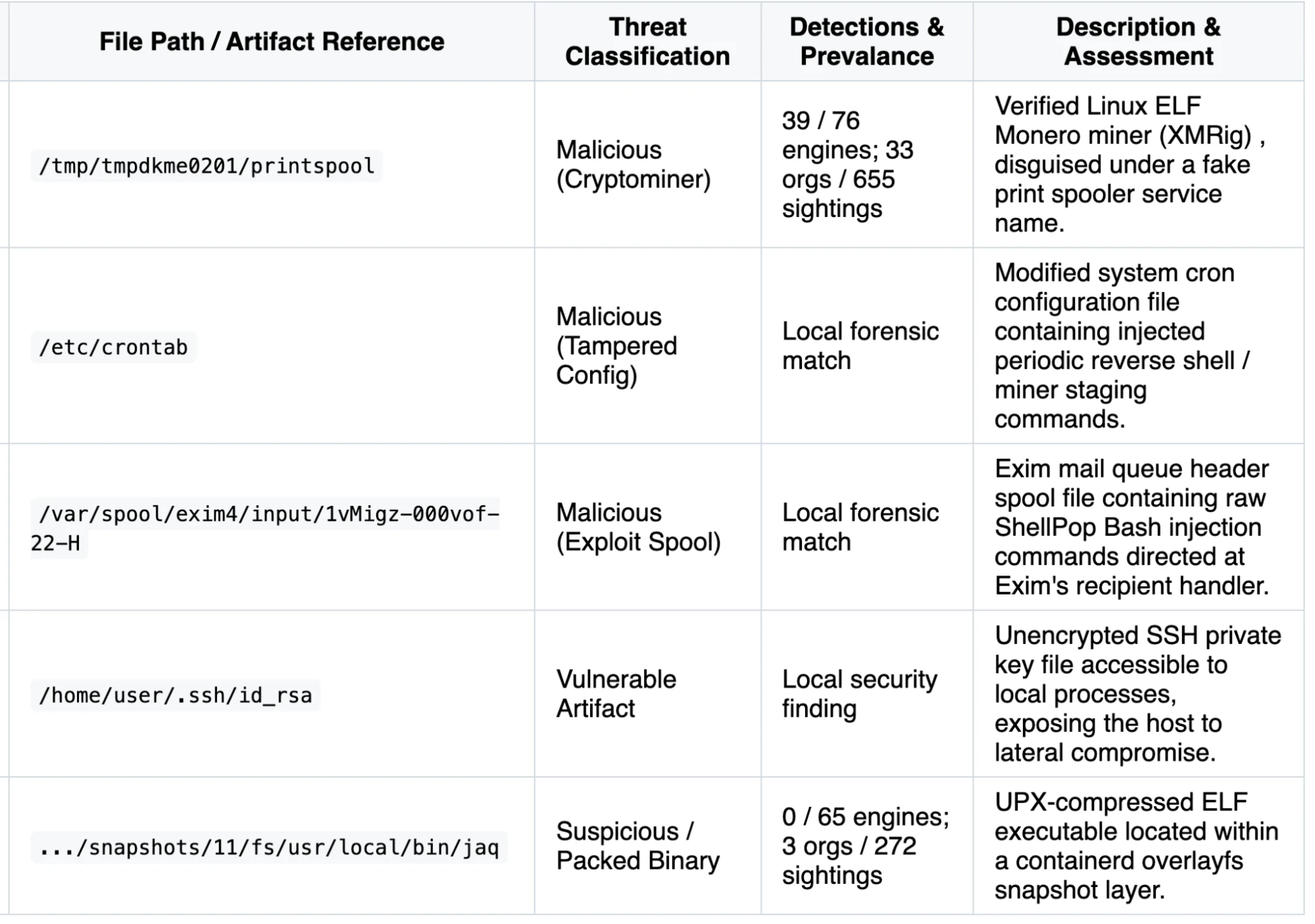
While the correlation confirmed printspool as a known cryptocurrency miner (39/76 detections), it also highlighted jaq—a binary inside a containerd overlayfs snapshot layer with 0/65 security engine detections that matched SUSP_ELF_LNX_UPX_Compressed_File. Because adversaries routinely pack custom loaders to evade static signatures, packed binaries with zero detections cannot be dismissed without verification.
Using OpenRelik's modular architecture, the responder extracts both binaries directly from the mounted filesystem to answer two follow-up questions across targeted sub-workflows:
-
What specific system and network capabilities does printspool possess?
-
Is jaq a stealthy persistence backdoor, or a benign packed utility?
Sub-Workflow 1: Capability Analysis (Capa + Google Threat Intelligence) of printspool
To determine what `printspool` is engineered to do without uploading the binary externally, build a two-stage sub-workflow (`agti_capa_printspool`) that chains OpenRelik's Capa worker with the Google Threat Intelligence worker:
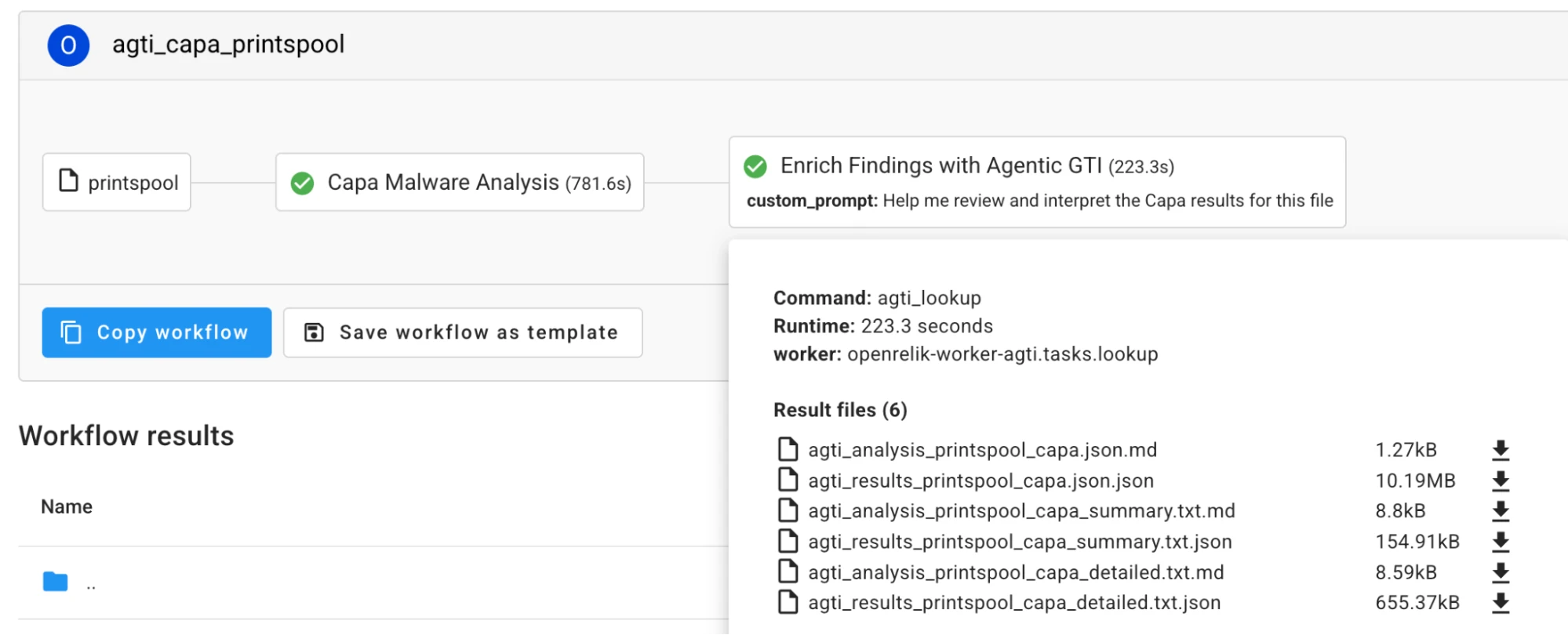
- Capability Identification (Capa): The Capa worker runs Mandiant's open-source capability identification engine inside an isolated container, scanning printspool against community rules to generate structured output files (printspool_capa.json, printspool_capa_summary.txt, and printspool_capa_detailed.txt).
-
Agentic Interpretation: Because Capa reports often list hundreds of low-level capability matches, namespaces, and instruction offsets, the analyst pipes the Capa output directly into the Google Threat Intelligence worker with a simple prompt: "Help me review and interpret the Capa results for this file"
-
Synthesized Behavioral Summary: Google Threat Intelligence translates the raw capability matches into a concise behavioral report (agti_analysis_printspool_capa_*.md), highlighting cryptocurrency mining routines, network socket initialization, and anti-analysis checks without requiring manual line-by-line review.
Sub-Workflow 2: AI-Assisted Reverse Engineering of jaq
Next, the responder investigates the UPX-packed jaq binary (SHA-256: a9de45b82196bf046341f5c214b3cbf2528adc3f1966aeeb29e61e9069ab960b) to determine whether its zero-detection status hides malicious logic:
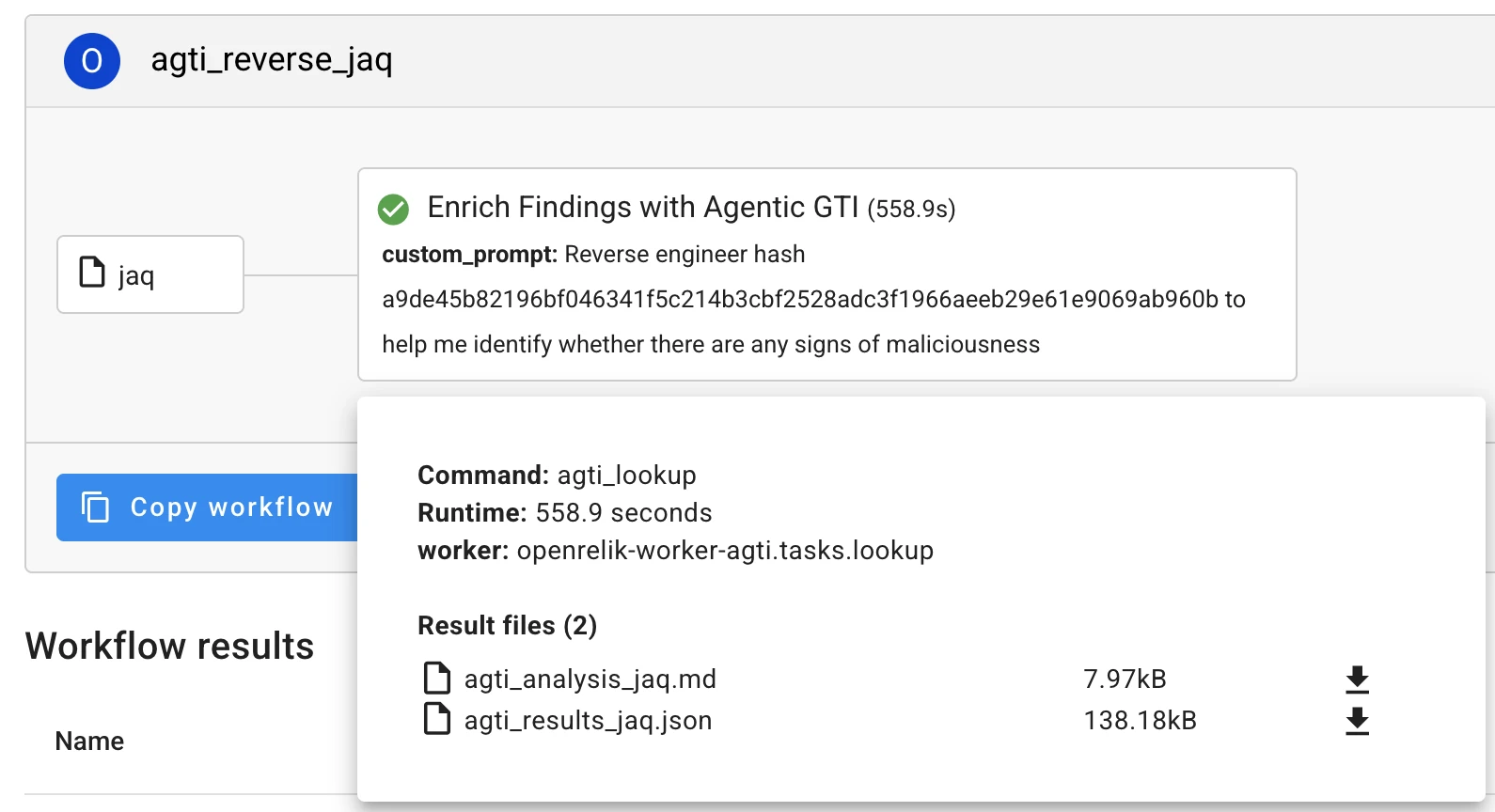
Rather than spinning up a local disassembler such as Ghidra and manually unpacking and reversing the binary, the responder delegates the task to Google Threat Intelligence using a targeted prompt:
"Reverse engineer hash a9de45b82196bf046341f5c214b3cbf2528adc3f1966aeeb29e61e9069ab960b to help me identify whether there are any signs of maliciousness"
Google Threat Intelligence performs automated static analysis across the binary's unpacked control flow and function symbols:
-
Exonerating the Binary: Analysis confirms that jaq is an open-source Rust clone of the jq JSON manipulation utility.
-
Explaining the Packing: The UPX compression was applied as a legitimate build optimization to minimize container layer sizes, rather than for defense evasion.
-
Closing the Lead: Eliminating jaq as a false positive allows the responder to focus remediation efforts on the confirmed Exim exploitation, cron persistence, compromised SSH key, and printspool miner.
Centralized Case Deliverables
Once the pipeline stages conclude, all intermediate and final outputs are organized inside OpenRelik's Workflow Results interface:
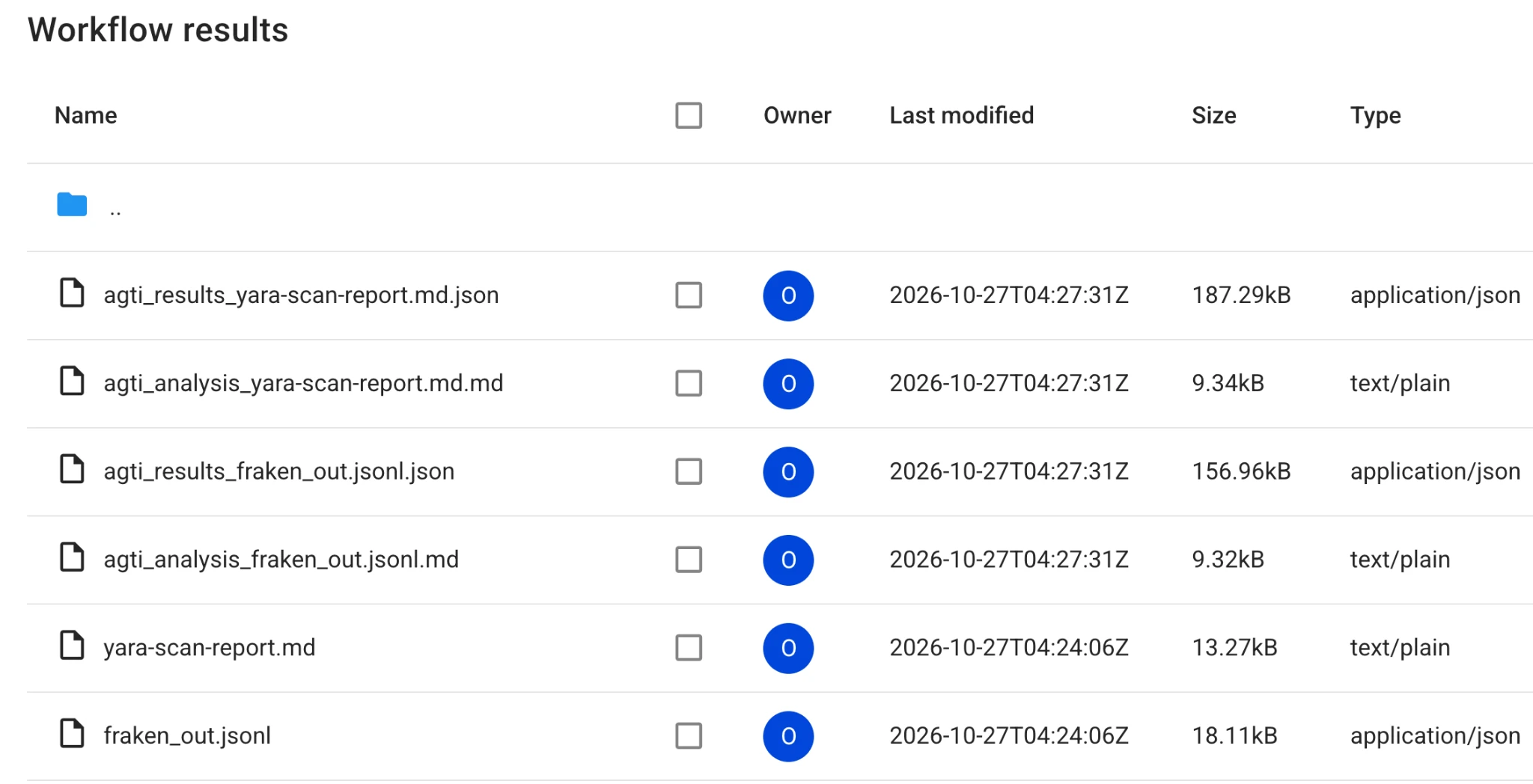
- Human-Readable Markdown Summaries: Persistent investigation notes documenting the matched rules, analytical rationale, and threat context synthesized at each step, ready for analyst verification and case management documentation.
-
Structured JSON Telemetry: Raw, machine-readable outputs capturing model responses, tool parameters, timestamps, and input metadata to ensure auditability, analytical reproducibility, and easy downstream parsing.
Beginning Your Integration Journey
Pairing OpenRelik's modular, containerized processing with the agentic capabilities in Google Threat Intelligence gives security teams a flexible blueprint for automating forensic triage—moving from raw disk evidence to verified root-cause context and targeted sub-workflows in minutes.
The scenarios shown here are just one example of how these building blocks can be combined. Because OpenRelik's workers and Google Threat Intelligence's custom prompts are decoupled, teams can adapt the pipeline to fit their own playbooks—whether piping raw strings outputs to extract embedded command and control (C2) configurations,or correlating large batches of candidate IOCs against active campaigns. We welcome your feedback and community contributions as you test and extend these workflows!
