PARSING-NORMALIZATION errors

  • January 15, 2025
  • 12 replies
  • 236 views

Rached1996
Forum|alt.badge.img+8

Hello Community , 

How i can identify parsing and normalization errors in Chronicle SIEM please ? 
Thanks

12 replies

rajukg11
Staff
Forum|alt.badge.img+6
  • Staff
  • January 15, 2025

sudeep_singh
Forum|alt.badge.img+6
  • Bronze 1
  • January 16, 2025

Hi @Rached1996 ,

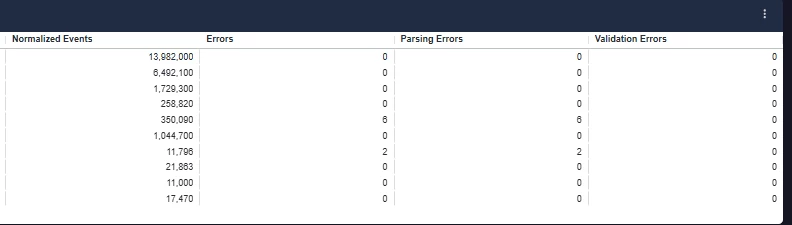
In Google SecOps under SIEM Dashboards Data ingestion and Health Dashboard there is a Tile named Ingestion - Events by Log Type there you can see the normalized events, parsing errors, etc.


Rached1996
Forum|alt.badge.img+8
  • Author
  • Silver 2
  • January 16, 2025

Rached1996
Forum|alt.badge.img+8
  • Author
  • Silver 2
  • January 16, 2025

Hi @Rached1996 ,

In Google SecOps under SIEM Dashboards Data ingestion and Health Dashboard there is a Tile named Ingestion - Events by Log Type there you can see the normalized events, parsing errors, etc.


Can i search these errors through UDM ? 
Iwant to know where exactly the error is , for exemple for o365 log type 


manoj610
Forum|alt.badge.img+4
  • New Member
  • January 16, 2025

Hi Rached,

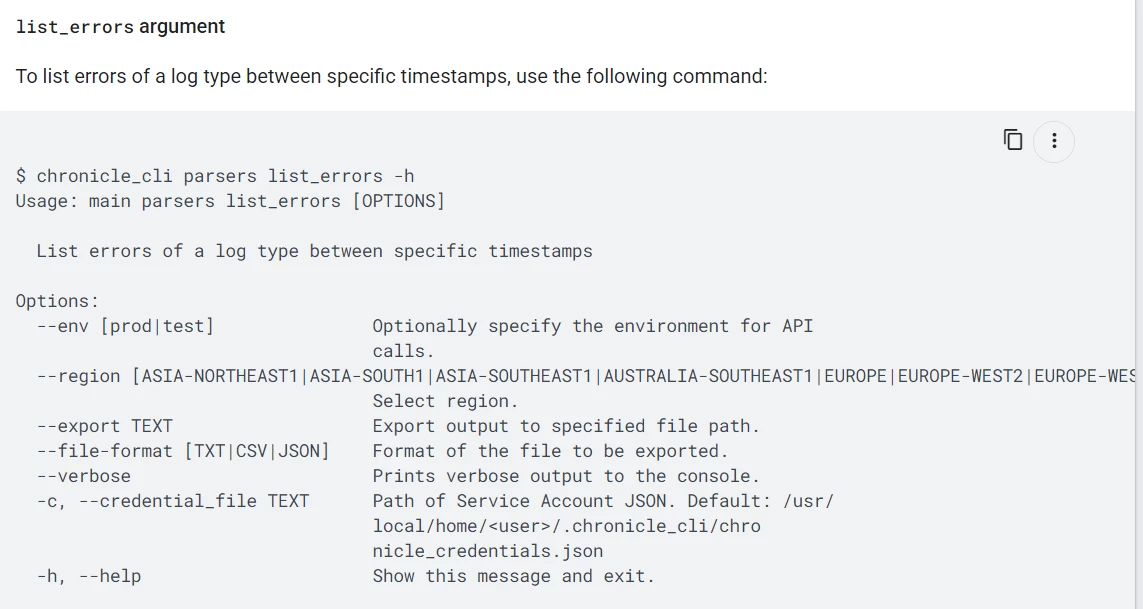
You this link to get the parser errors.
Google Security Operations CLI User Guide  |  Google Cloud


sudeep_singh
Forum|alt.badge.img+6
  • Bronze 1
  • January 17, 2025

Can i search these errors through UDM ? 
Iwant to know where exactly the error is , for exemple for o365 log type 


Hi @Rached1996 ,

I'm not sure about getting the error through UDM, but if you do raw log search and then if you see the event_type there will unparsed logs and you can check which logs are getting error and finetune the parser accordingly.


Rached1996
Forum|alt.badge.img+8
  • Author
  • Silver 2
  • January 20, 2025

Hi @Rached1996 ,

I'm not sure about getting the error through UDM, but if you do raw log search and then if you see the event_type there will unparsed logs and you can check which logs are getting error and finetune the parser accordingly.


Thanks for the reply 
how can i know where the problem is in the parser ? i mean the problem causing the unparsed log


sudeep_singh
Forum|alt.badge.img+6
  • Bronze 1
  • January 20, 2025

Thanks for the reply 
how can i know where the problem is in the parser ? i mean the problem causing the unparsed log


Hi @Rached1996 ,

While validating the parser you will get which particular log is having an error.
with that particular log you will see what is the error and make necessary changes in the parser.


rajukg11
Staff
Forum|alt.badge.img+6
  • Staff
  • January 20, 2025

Also, you can look for the unparsed logs in the UI.  You should go to Legacy Raw Log Search (top right on SIEM search) and then do a RLS on the log type you are interested in.  Once the results show up, on the right side in the Procedural Filtering, choose Even Type drop down and look for Unparsed logs and choose show only on that.


HubCity_mtb
Forum|alt.badge.img+1
  • Bronze 1
  • April 3, 2025

I was wondering why the current search capability does not have either the procedural filter. I can see events tagged as Type of "unparsed_raw_log" in the raw logs table but the Aggregations filter does not recognize these and there is no filter to only show "unparsed_raw_log" types in the current UI. Why is this? I'd assume the legacy search will one day go away, seems inefficient to keep two search tools.


Sudheerzscaler
Forum|alt.badge.img+2

can we group the  results of this API by the error message, like suppose there are 200 results, but exact errors are due to 2 reasons and there are 100 logs for each, so if we can group the error message or if we can limit the results


darrenswift
Staff
Forum|alt.badge.img+4
  • Staff
  • April 28, 2026

Aggregation filters within UDM search are only for parsed logs. Raw log search is available outside of legacy search - https://docs.cloud.google.com/chronicle/docs/investigation/raw-log-search-in-investigate

Regarding the CBN filters - it filters on errors, for any aggregation or filtering you can modify the output or use any python function(s).