Question

Understanding Remote Agent Hosting in Private Networks for Google SecOps SOAR

  • January 24, 2026
  • 1 reply
  • 16 views

SaitejaKatta
Forum|alt.badge.img+3

Hello Community,

I am trying to clearly understand the design and deployment model of Google SecOps SOAR Remote Agents, specifically when the target systems (for example, FortiGate firewalls or other on-prem security tools) are hosted inside a private customer network.
 

I would like clarification on the following points:

  1. Hosting Model

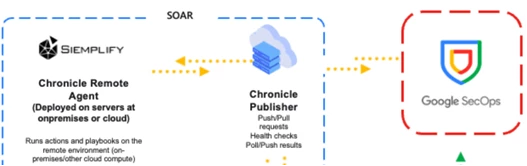
    • Do we need to create a VM in the customer private network to host remote agent?

    • Is the Remote Agent always expected to run on a dedicated VM or server inside the customer’s private network?

    • Is this the recommended and supported architecture for interacting with internal devices such as firewalls, AD, or other non-internet-exposed systems?

  2. Allowing Access for Remote Agent to Google Publisher and Firewall
1 reply

Eoved
Forum|alt.badge.img+8
  • Bronze 2
  • January 25, 2026

Hello,

1.

 You can create the agent on a Linux server (RHEL 8.7 / clean CentOS 7.9) or using Docker/Podman.

You can, and it might not be a “hard” technical requirement.

This is the recommended way to respond via SOAR with security tools and devices within your local environment.
 

References:

https://docs.cloud.google.com/chronicle/docs/soar/working-with-remote-agents/remote-agents-architecture-overview

https://docs.cloud.google.com/chronicle/docs/soar/working-with-remote-agents/requirements-and-prerequisites
 

2.

The most critical part of this design is that communication is outbound only (from your network to Google).
 

You do not need to open any incoming ports from the internet.

You need to allow outbound traffic over port 443 from your agent to your instance URL (publisher only).

It also supports proxy configurations.

References:

https://docs.cloud.google.com/chronicle/docs/soar/working-with-remote-agents/data-flows-and-protocols