


What’s New in Google SecOps for the interval Nov 16th through Nov 22nd, 2026.
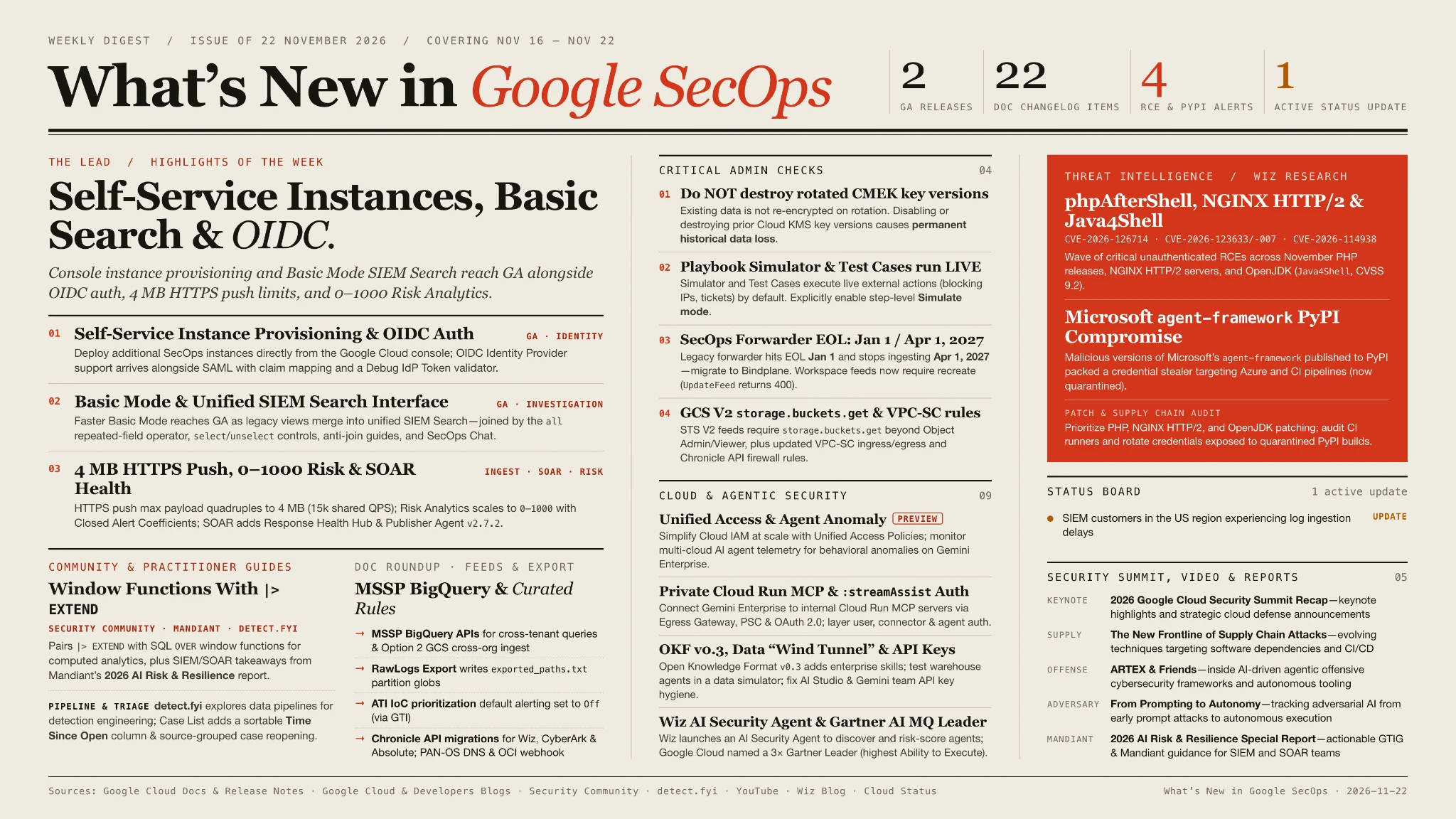
Highlights
In Google SecOps and cloud security news:
-
🚀 Google SecOps reached GA for self-service additional instance provisioning via the Google Cloud console and Basic Mode SIEM Search.
-
📄 This week's condensed Google SecOps Documentation Updates include critical administrator callouts on CMEK key rotation data loss, the deprecated SecOps Forwarder EOL timeline (Jan 1 / Apr 1, 2027), and Playbook Simulator live execution vs. Simulate Mode, alongside OIDC auth, 4 MB HTTPS push limits, the all repeated-field operator, and expanded 0-1000 Risk Analytics scoring.
-
🤖 Google Cloud previewed Unified Access Policies and Agent Anomaly Detection, published OKF v0.3, shared patterns for connecting internal Cloud Run MCP servers to Gemini Enterprise, and earned Leader in the 2026 Gartner Magic Quadrant for AI Application Development Platforms.
-
🐛 Wiz introduced the Wiz AI Security Agent and detailed critical RCEs across PHP (phpAfterShell), NGINX HTTP/2, and OpenJDK (Java4Shell), plus a PyPI compromise of Microsoft's agent-framework.
-
🌍 In community, video, and platform updates, the Google Cloud Security Community covered the Mandiant 2026 AI Risk and Resilience report and window functions with |> EXTEND, Google Cloud Security posted four new YouTube sessions (including the 2026 Security Summit Keynote Recap), and Google Cloud Status reported US region log ingestion delays.
Product Updates & New Features
Google SecOps
🚀 Release Notes from Google Cloud Docs
-
Google SecOps has launched self-service additional instance provisioning as Generally Available (GA), allowing subscribed customers to deploy new instances directly from the Google Cloud console. Read More
-
Basic Mode search on the SIEM Search page has reached General Availability (GA), providing users with a faster search execution mode. Read More
📄 Documentation Updates (Condensed Summary) from Google Cloud Docs
Trying a new condensed format this week to summarize Google SecOps documentation updates by area rather than listing each page individually.
Action Items for Administrators
-
⚠️ CRITICAL: Do Not Destroy Rotated CMEK Keys: Existing data is not automatically re-encrypted after a key rotation. Disabling or destroying previous Cloud KMS key versions after rotation will cause permanent data loss for historical data encrypted with those versions.
-
Update IAM Roles for Cloud Storage V2 Feeds: Storage Transfer Service (STS) for V2 feeds explicitly requires the storage.buckets.get permission. Relying solely on Storage Object Admin or Storage Object Viewer roles will lead to Permission Denied errors.
-
☠️ Migrate from the Deprecated Google SecOps Forwarder: The legacy Google SecOps forwarder is deprecated, reaches end-of-life on January 1, 2027, and will cease data ingestion on April 1, 2027. Administrators must plan migrations to the Bindplane agent.
-
Workspace Feed Modification Workflow Changes: In-place editing is no longer supported for most Workspace feeds (WORKSPACE_ACTIVITY, ALERTS, CHROMEOS, GROUPS, MOBILE, USERS). Calling UpdateFeed returns HTTP 400 INVALID_ARGUMENT; to rotate keys or change configurations, delete or disable the old feed and create a new one.
-
Update Network & Firewall Configurations: VPC Service Controls require new ingress/egress rules for Cloud Storage V2 feeds, and new firewall guidelines detail required endpoints and IP ranges for the Chronicle API.
Ingestion & Feed Management
-
Increased HTTPS Push Feed Limits: Maximum single request or log line size for HTTPS push feeds (and Chronicle API methods) increased from 1 MB to 4 MB. The 15,000 QPS throughput limit is shared across all HTTPS push feeds per instance and cannot be increased.
-
Expanded Cloud Storage Option 2 Ingestion: Docs now cover assigning asset namespaces or ingestion labels, ingesting logs from independent Google Cloud organizations without direct IAM access (useful for MSSPs), and multi-log-type handling via specific bucket URIs.
-
New Parsers and API Migrations: Wiz, Absolute Secure Endpoint, and CyberArk integrations have migrated to the Chronicle API. The Palo Alto Networks Firewall parser now supports DNS and Config logs, and Oracle Cloud Infrastructure Audit added a webhook ingestion method.
Investigation & SIEM Search
-
Unified SIEM Search Interface (GA): Legacy standalone investigative views (Asset, IP, Domain, Hash, User) have been deprecated and consolidated into the unified SIEM Search experience. A single query editor supports UDM events, entities, alerts, and raw logs, with Basic Mode now GA.
-
New all Query Operator for Repeated Fields: Use the all operator to check whether every element in a repeated UDM field satisfies a condition, addressing unexpected behavior with != or empty-value checks.
-
UDM Search Output Control and SecOps Chat: Added select and unselect keywords to control fields returned in search results, along with an AI-powered SecOps Chat assistant for YARA-L generation, threat intelligence research, and investigation.
-
Data Tables Join Syntax Guide: Expanded guidance on row-based combination exclusions (left anti-joins) with warnings against incorrect inequality operators.
-
Time Since Open Column for Investigations: A sortable "Time Since Open" column is rolling out to the Case List table to help prioritize triage queues.
SOAR & Playbooks
-
⚠️ Critical Playbook Simulator Behavior Change (Simulate Mode): Playbook Simulator and Test Cases run actions live against connected external products by default (e.g., blocking IPs, creating tickets). A new "Simulate mode" must be explicitly enabled at the step level to prevent live execution.
-
Test Case Isolation Warning: Test cases are isolated copies, not sandboxed environments. Playbooks run on test cases will still interact with connected integrations unless Simulate mode is enabled.
-
Response Health Hub & SOAR Statistics: Introduced the Response Health Hub dashboard for monitoring playbook performance, execution latency, and integration health, plus options to select case/event properties for statistical alert analysis.
-
Alert Grouping Enhancement: A new setting allows closed cases to be reopened when grouping by source instead of creating duplicate cases.
Platform Administration & Identity
-
OpenID Connect (OIDC) Authentication Support: Added comprehensive OIDC Identity Provider support alongside SAML, including claim mapping configurations and a Debug IdP Token validation tool.
-
Self-service Additional Instance Provisioning: Customers with an active Google SecOps unified subscription can deploy additional instances directly from the Google Cloud console.
-
MSSP Advanced BigQuery Export Support: Added workflows and APIs (ProvisionPartnerSubscription, fetchSubscriptions) for MSSPs to configure centralized access and cross-tenant querying of sub-tenant BigQuery data.
-
Publisher Agent Version 2.7.2 Updates: Adds lazy loading for remote action tasks (reducing payload sizes), fixes integration dependency installations, and resolves self-destruction script permission issues for remote agents.
Detection, Analytics & Reporting
-
Risk Analytics Score Range and Settings Updates: Default detection risk score range expanded from 0-100 to 0-1000, and a new "Closed Alert Coefficient" setting was added to entity risk score configurations.
-
ATI Curated Detections Default Alerting Behavior: Default alerting for IoC prioritization rule sets is now set to Off (including High priority rules), with Google Threat Intelligence specified as the source for IoC evaluations.
-
Export RawLogs Completion Manifest: The Data Export API now generates an exported_paths.txt manifest file for successful jobs listing glob patterns for exported partitions, simplifying downstream automation without full bucket listings.
Google Cloud
✍️ 🚀 How to simplify cloud access with Unified Access Policies, now in preview from Google Cloud Blog
-
Introduces Unified Access Policies, now in preview, designed to simplify cloud access and address the operational bottlenecks of Identity and Access Management (IAM) at scale. Read More
✍️ Frontier and Center: Why your data agents need a “wind tunnel” from Google Cloud Blog
-
Proposes using a data simulator, or "wind tunnel," to test data agents that interact with enterprise data warehouses, addressing data sensitivity, access restrictions, and incomplete catalog descriptions in production environments. Read More
✍️ Ultimate guide for fixing your team’s API keys from Google Cloud Blog
-
Provides a guide on how to properly manage and fix API keys for teams, particularly for Google AI Studio and Gemini prototypes, balancing development speed with security. Read More
✍️ 🚀 What’s new in OKF v0.3: enterprise-ready knowledge, use cases, and skills from Google Cloud Blog
-
Introduces new features in Open Knowledge Format (OKF) v0.3, focusing on enterprise readiness, use cases, and skills for providing context to agents. Read More
✍️ Google Cloud is a Leader in the 2026 Gartner Magic Quadrant for AI Application Development Platforms from Google Cloud Blog
-
Google Cloud has been recognized for the third consecutive time as a Leader in the 2026 Gartner Magic Quadrant for AI Application Development Platforms, achieving the highest position for Ability to Execute. Read More
✍️ How to securely connect internal Cloud Run MCP servers to Gemini Enterprise from Google Developers Blog
-
Details methods for securely and privately connecting Gemini Enterprise to internal StreamableHTTP MCP servers on Cloud Run using Egress Agent Gateway, Private Service Connect, and OAuth 2.0 authentication. Read More
✍️ 🚀 Agent Anomaly Detection: Safeguarding agents across other clouds from Google Developers Blog
-
Introduces Agent Anomaly Detection in private preview, monitoring AI agents for unusual behavior including those operating outside of Google Cloud. Read More
✍️ Securing Your Agents: A Hands-On Guide to Agent Anomaly Detection from Google Developers Blog
-
Walks developers through setting up Agent Anomaly Detection on the Gemini Enterprise Agent Platform to monitor AI agent telemetry, detect behavioral risks, and configure proactive alerts. Read More
✍️ How to handle user, connector, and agent auth in Gemini Enterprise with a custom UI from Google Developers Blog
-
Guides developers through implementing three authentication layers for custom UIs built on Gemini Enterprise's :streamAssist API: user, connector, and agent authentication. Read More
Community & Events
✍️ Key Takeaways from the Mandiant special report 2026: AI risk and resilience from Google Cloud Security Community
-
Shares key takeaways from the Mandiant and GTIG 2026 special report on AI risk and resilience for SecOps teams, with practical insights for SIEM and SOAR. Read More
✍️ New to Google SecOps: Head OVER Heels for Window Function Calls with |> EXTEND from Google Cloud Security Community
-
Continues exploring the |> EXTEND pipe operator in Google SecOps, showing how to combine it with SQL window functions to build new computed columns and advanced analytics. Read More
3rd Party Blogs
✍️ Data Pipelines: Unlocking the Full Potential of Detection Engineering from detect.fyi
-
Explores how data pipelines can be used to optimize and expand detection engineering capabilities. Read More
Podcasts & YouTube
🎥 Google Cloud Security Summit | Keynote Recap 2026 from YouTube
-
A recap of the 2026 Google Cloud Security Summit keynote. Read More
🎥 The New Frontline of Supply Chain Attacks from YouTube
-
Explores the evolving landscape and emerging techniques used in supply chain attacks. Read More
🎥 ARTEX and Friends: Enter Agentic Offensive Frameworks from YouTube
-
Introduces agentic (AI-driven) offensive cybersecurity frameworks, focusing on ARTEX and related tooling. Read More
🎥 From Prompting to Autonomy: The Evolution of Adversarial AI from YouTube
-
Covers the evolution of adversarial AI from early prompting methods to autonomous capabilities. Read More
Wiz
✍️ 🚀 Introducing the Wiz AI Security Agent from Wiz Blog
-
Wiz introduces its AI Security Agent, designed to discover and analyze other AI agents, understand their purpose, and surface potential security risks. Read More
✍️ phpAfterShell and Critical PHP RCE Vulnerabilities: Everything You Need To Know from Wiz Blog
-
Covers phpAfterShell and other critical PHP RCE vulnerabilities from PHP's November release, with guidance on detection and mitigation. Read More
✍️ Unauthenticated Remote Code Execution in NGINX: CVE-2026-123633 and CVE-2026-123007 from Wiz Blog
-
Details two critical HTTP/2 flaws (CVE-2026-123633 and CVE-2026-123007) in NGINX that allow unauthenticated remote code execution. Read More
✍️ CVE-2026-114938 RCE in OpenJDK: Everything You Need to Know from Wiz Blog
-
Details CVE-2026-114938 (Java4Shell), a critical 9.2 RCE vulnerability impacting OpenJDK and Java applications, along with detection and mitigation steps. Read More
✍️ Microsoft agent-framework Compromised: Credential Stealer Targets Azure and CI Pipelines from Wiz Blog
-
Malicious versions of Microsoft's agent-framework PyPI package were published containing a credential stealer targeting Azure and CI pipelines; the packages have since been quarantined. Read More
Platform Issues
✅ UPDATE: Google Security Operations (SIEM) customers in the US region are currently experiencing log ingestion delays. from Google Cloud Status
-
Google Security Operations (SIEM) customers in the US region are experiencing log ingestion delays. Read More
